By Greg
Join us in celebrating the winners of the 2010 Ed Bacon Student Design Competition and the recipient of the 2010 Edmund N. Bacon Prize:
DENISE SCOTT BROWN, RIBA, Int. FRBIA
Principal, Venturi, Scott Brown & Associates; Author, Learning from Las Vegas + more
Tuesday, December 07, 2010
6:00 - 6:45 pm Opening Reception
6:45 - 8:15 pm Presentation of Awards & Lecture by Denise Scott Brown
8:15 - 9:00 pm Closing Reception
$75 General Public
$25 Student or AIA Associate
Register online
Thursday, November 11, 2010

Monday, October 25, 2010
Architecture in Film + Book Talk: Ed Bacon
By Greg
Please join me for this event Thursday:
Architecture in Film + Book Talk: Ed Bacon
Thursday, October 28, 2010
7 to 9 p.m.
Presented by the Center for Architecture
Registration required. To register, click here.
Please join the Center for Architecture for a screening of selections from the film series "Understanding Cities" (1984) produced by Edmund N. Bacon. The screening will be followed by a panel discussion featuring:
• Michael Bacon, Co-producer of the "Understanding Cities" films with his father.
• Gregory Heller, Managing Director at The Enterprise Center Community Development Corporation and Chairman of the Ed Bacon Program Committee
• Scott Gabriel Knowles, Ph.D., editor of "Imagining Philadelphia: Edmund Bacon and the Future of the City" (2009)
• Moderated by Julie Hoffman, AIA, President-Elect of AIA Philadelphia
This event is part of a series hosted by John DeFazio, AIA (Architect & Associate Professor @ Drexel University) and Nick Groch, Assoc. AIA, which screens films that explore ideas and themes on architecture and architects. The theme for all films in the 2010/2011 series is "The City." Discussion is encouraged.
Sunday, October 10, 2010
This I Believe
By Ariel
For most people that first moment of liberation, of freedom, comes when they are handed their first car keys at sixteen. Mine came when I was twelve when I got my first trail pass. I still have the small yellow card with its bright red number 2. And to this day it's packed away in a box filled with the others just like it that I carried throughout middle school and high-school.
Suddenly the city was mine as I hopped on the train to go to school, the bus or subway to visit friends. I didn’t have to worry about learning how to parallel park or drive, all I did was jump on the next schedule bus and the city was mine.
Riding SEPTA was not just about a new freedom of movement I never had before. It was also about discovering new friends. I began to meet my neighbors, people I had grown up with but never knew lived right around the corner. Seeing these people day in and day out helped me gain a sense of community I never got when I was chauffeured around.
Later, when I took a year off of college to work at a local bakery, the Night Kitchen in Chestnut Hill, I was lucky that the very last train on the Chestnut Hill East line got me to work at 1 AM, the exact right time to start making muffins and cinnamon buns. If I missed it, the 23 took me through the heart of North Philly to the front door of the bakery.
I was raised in a neighborhood that grew up around the city’s first train lines. As an urban planner I can think of hundreds of reasons why transit is good for cities. But I don't need theory. Every day I see with my own two eyes how transit makes it easier to support thriving communities. Today I work in the Mayor’s Office of Transportation and Utilities because I have seen the impact transit has had on my city.
I believe that we as a region need to invest in our public transportation system, not simply because it is what economists call a “public good”; but because everybody should be so lucky to have transit lines to get them to work at 1 in the morning. And everybody should find new opportunities to make friends and meet their neighbors.
Tuesday, August 17, 2010
Complex Problems, Complex Solutions

By Greg
University of Pennsylvania professor and former Daily News Columnist Mark Allan Hughes once wrote critically of “a world that demands simple solutions for complex problems…” The need for understanding and addressing the subtle and complex realm of urban development and public policy is the unspoken premise of John Kromer’s new book, Fixing Broken Cities: The Implementation of Urban Development Strategies. Kromer, a veteran civil servant, professor, and policy consultant, presents extraordinarily complex problems through the lens of someone who has been there, fought the battles, and can now reflect on what works and what doesn’t. The book delves deep into policy issues, but is very readable and generally jargon-free. For anyone who is involved in urban development or ever wants to be, Fixing Broken Cities, is a must read.
Kromer, who now roosts at the Fels Institute of Government at Penn, spent a career deep in the trenches of urban housing and community development. But he is quick to point out, “I do not have a degree in city planning, economics, or public administration; I have no political credentials to speak of…” Kromer’s qualifications come from raw experience. He worked his way up through the bureaucracy of Philadelphia’s housing agencies to become the City’s housing director and briefly the head of the Philadelphia Housing Authority. Later he temporarily headed Camden, New Jersey’s redevelopment effort, and more recently served as a consultant to Allentown, Pennsylvania. The book provides a detailed tour through Kromer’s career, focusing on each city and transferring ideas from one case study to the next, while providing exposure to the challenges and political battles that arose along the way.
Kromer explains that he has “devoted most of my career to implementing downtown and neighborhood reinvestment strategies in cities that are disinvested, de-populated, and cash-starved.” He writes about his episodes experiencing tough political realities, infuriating bureaucratic logjams, and staggering problems that needed to be solved with next to no resources. Such a career would have driven many out of public service. However, Kromer not only slogged through, he seems to have drawn strength from the utter complexity of massive urban dilemmas, feeding an endless optimism and faith that the future can be better.
In some ways Fixing Broken Cities is a sequel to Kromer’s earlier book, Neighborhood Recovery: Reinvestment Policy for the New Hometown. The two books deal with similar problems and ideas, but now Kromer has more experience under his belt, and the concepts in Fixing Broken Cities are often more defined, evidence-based, and pragmatic. The new book’s title captures Kromer’s optimism, expressing the idea that some cities are broken, but they can be fixed, and as the title implies, the book will show us how it can be done.
Much of the book focuses on the city where Kromer spent the lion’s share of his career – Philadelphia. Since the low point of Philadelphia’s urban decline in the 1980s, the city has seen a stream of programs and initiatives focused on downtown and community reinvestment. Kromer provides a survey of these programs, connecting them and providing first-hand perspective on their intended results, strengths, weaknesses, and impacts. The reader comes away seeing that Philadelphia’s recent resurgence is surely not accidental.
The programs and initiatives span from city and state tax credits and abatements, to the advent of Center City District, investments by the University of Pennsylvania in West Philadelphia, and the City’s Neighborhood Transformation Initiative. Kromer never argues that these interventions were based on a single plan, ran smoothly, or were truly connected. However, he shows how collectively they built upon each other in a powerful and incremental way.
In the book, Kromer proceeds point by point to show how these programs played out. For example, he discusses the success of Philadelphia’s tax abatement program in attracting new development downtown and in promoting the rehabilitation of blighted and abandoned buildings. He uses this program to highlight challenges, namely that in a strong economy the abatement becomes a tax break for the rich. His solution: “Use post-abatement term tax revenue to support affordable housing.” Overall, he dubs this program, which continues to be controversial in Philadelphia, “a success in economic development terms and a failure in terms of human capital development.”
Kromer also goes into great detail about the implementation of Philadelphia’s massive Neighborhood Transformation Initiative (NTI) under Mayor John Street, which Kromer argues was flawed from beginning because “program decisions were being made in the absence of planning.” He explains, “If Mayor Street had identified community planning as the first step in redefining the working relationship between municipal government and neighborhoods, then every municipal agency would have been involved in the citywide dialogue.” Instead, Kromer swipes at the program, noting how it devolved into a “politically motivated” strategy that did little more than “improve the City’s ability to assemble land for development.”
The discussion of NTI is not entirely critical, but Kromer also notes, “Most of the development that occurred in Philadelphia during Street’s eight-year tenure was not NTI-financed.” The big point he leaves readers with is that “a transformation of neighborhoods could not be undertaken successfully unless preceded by a transformation of government.” One of the book’s great strengths is that Kromer never cites mistakes without proposing solutions. He always lays out a list of ideas, in this case including having the Mayor appoint a development policy chief, and giving the City’s Redevelopment Authority right of first refusal on foreclosure-eligible properties before they go to Sherriff sale or auction.
In his chapter about the revitalization of West Philadelphia, Kromer heaps praise on the series of interventions taken by the University of Pennsylvania, under its past President Judith Rodin, to invest in the communities surrounding the university. Kromer argues that this type of investment by place-based institutions is critical in today’s economy. He writes, “Many of these institutions cannot move to new sites; they have to succeed in place.” Penn developed a powerful approach, but encountered many naysayers about what could succeed in the marketplace. Kromer notes that Penn’s strategy also required a strong understanding of urban development, and “there was no opportunity for a suburban developer to play any constructive role.”
After discussing Philadelphia for over 200 pages, Kromer dedicates half as much ink to discussions of Camden and Allentown. This disproportionate focus on Philadelphia reflects the duration of the author’s own experiences. Yet the inclusion of other cities is valuable – broadening the book’s perspective. For example, during his stint directing Camden’s redevelopment program, Kromer had to deal with a small city under a state takeover, with different levels of government at odds as to who was in charge. It was a wholly different situation from the one he experienced in Philadelphia.
The account of the messy attempts in Camden to gain approval for redevelopment plans and attract developers is detailed and comprehensive. However, by the end of the Camden discussion, Kromer steps back to note a larger issue, sounding a less-than-subtle call to action: “The real barrier to Camden’s future success was the absence of a new generation of civic leadership... The places with the greatest potential to contribute to the growth of civic leadership in Camden are the city’s academic and health care institutions...”
In Allentown, the issues diverge even farther from those in Philadelphia. The Allentown City government brought on Kromer to advise on policies to address “the destabilization of neighborhood blocks, as a result of large-scale conversions of single-family homes to multi-family properties.” Kromer runs through an array of policy interventions to deal with the problems of a place that has seen significant real estate interest in purchasing investment properties – shifting a city of homes to one overrun with rental units, and the issues that arise from absentee landlords.
One of the intriguing elements of Fixing Broken Cities is that Kromer is clearly a participant in the narrative, not just an observer. For example, after the completion of new housing in North Philadelphia, Kromer received criticism for allowing “suburban-style” development, without a mix of uses or supportive services. Some of this criticism came from Mayor John Street’s wife in the middle of a meeting. Kromer writes, “So how do you respond to criticism from the Mayor’s wife? … Who did she think I was, Robert Moses, Jr.?” These types of entertaining episodes remind the reader that this is not a textbook or a sterile academic treatise. Rather it is a no-holds-barred, personal story and an honest assessment from someone who was there, and who still is.
In perhaps the most personal chapter, Kromer steps back from high-level policy and focuses on his own West Philadelphia community, and the controversial plans to redevelop an abandoned fire house into a farmers market. Even here, so close to home, he does not shy away from tough issues, delving into the dangerous waters of race and community politics. He asserts, “The best plan for the fire house would be one that appealed to both whites and blacks and brought residents from both sides of the 50th Street divide together in an unforced, spontaneous way.” Using maps and data he convincingly shows how local perceptions of gentrification that created roadblocks for the project were not, in fact, the reality.
Kromer writes, “The controversy over the fire house was not a symptom of gentrification; it was a disagreement among a relatively small number of middle-class residents, most of whom had not grown up in the community… based on their perceptions – well-founded or unfounded – of what community should be.” He closes the chapter noting that the farmers market failed, but that the property’s current incarnation as a brewpub created “a valuable economic asset,” whose clientele is “primary white and under thirty.”
In a final chapter titled “The Future of Reinvestment,” Kromer argues that today’s landscape demands fresh thinking; the era of big government-supported urban renewal is over. Kromer writes, “the rules have changed; the money is spent; the show is ending.” In this chapter, he outlines “ten ways in which many city governments are unprepared to address the challenges and opportunities associated with twenty-first century reinvestment.” This section includes arguments like “Postindustrial cities and the states where they are located need a qualified twenty-first-century workforce more than anything else.”
He takes a biting swing at Habitat for Humanity arguing, “The last thing that highly distressed urban communities need is more low-income housing – and that is exactly what Habitat is producing in many urban areas.” He also criticizes the common strategy of cities requiring a certain percentage of business to go to certified minority-owned companies, arguing, “The reason why this approach fails is because the government mandate is not linked to a business services progress that is designed specifically to help small minority and neighborhood contractors develop the capability to bid competitively on city contracting and vending opportunities.”
However, he does not end on a pessimistic note. Kromer closes the chapter summarizing some of the major policy solutions that emerged from the book’s various chapters, connecting them to who should implement them (federal, state or local government, or institutions like universities and hospitals). For example, he encourages states to focus on both housing development and job training to a higher degree, and institutions to create incentives for employees to buy houses nearby their campuses and “to support one or more public schools.”
The book’s closing message is that cities require a focus on sustainability, but not in the environmental sense. Kromer explains, “Urban assets are unlike wetlands or wildlife areas; in order to preserve their intrinsic value they need to change; preservation and adaptation need to be linked.” This message is a powerful challenge. Do we understand our urban places well enough to value their preservation? Are we savvy and innovative enough to know how to adapt?
Fixing Broken Cities is fascinating and enlightening – surely one of the most important accounts of urban reinvestment policy that has come out in recent times. Kromer has a deep institutional memory and is a keen policy analyst. In the end, the book’s main lesson is that simple solutions will not cut it. Kromer argues “business leaders tend to like policies that are straightforward, clearly articulated, and easy to grasp.” Throughout the book, Kromer is clear that government, the private sector, and institutions need to think more long-term and comprehensively. Forget about the short-term, the easy-to-understand, the sexy initiative that can be communicated in a sound bite. They lack the power to be game changers.
Tuesday, August 3, 2010
DRPA debated on WHYY
By Ariel
What is most interesting about this debate is MYK's consistent attempt to attack the DRPA institution, and how often it missed the mark. I counted only three instances where I found her criticisms right on the money. More often they displayed a lack of understanding of how these institutions work and why they do what they do.
No wonder our government has such a hard time explaining itself to the public, when the media itself does not understand what the imperatives of our institutions are. What they react to is a press that insists on anthropomorphizing our institutions and insisting they act like people not agencies.
This was one of the most riveting debates I have heard in some time and urge you all to listen.
Monday, July 12, 2010
Community Planning Guidelines Approved!
By Greg
Last month I posted about a set of Community Planning Guidelines that the Philadelphia City Planning Commission was considering. Yesterday at its monthly hearing, the Planning Commission officially approved those guidelines. This is an important step forward for the City.
Many neighborhoods have been creating community plans, at great time and expense, but there was no real link between these plans and City policy. On the flip side, the Planning Commission had no way of ensuring that these community plans were inclusive and open, or that they were consistent from neighborhood to neighborhood.
These new guidelines would require community plans to meet a set of criteria in order to gain "acceptance" by the Planning Commission. These criteria include involving the Planning Commission in the planning process, having open community meetings, being consistent with the City's official plans, reaching out to stakeholders, and having competitive bidding for plans paid for with public dollars.
On the Planning Commission's part, it will issue an acceptance letter and post accepted plans on its website, creating a catalog of current accepted plans for each part of the city. These plans will generally serve as the basis for future public planning efforts, and for policy recommendations related to zoning, land disposition, and capital funding. In this way, community plans will be directly related to City policy decisions.
One former long-time Planning Commission staff member testified yesterday, cautioning that these guidelines could give the green light to outsourcing community planning. However, in some ways these guidelines are more a response to the multitude of independent community plans that have already surfaced of late. There are certainly challenges and potential pitfalls to community-run planning processes. However, when done well they produce plans that have the kind of buy-in that is difficult to achieve through a City-run planning process.
Philadelphia is lucky to have such a passionate citizenry, willing and wanting to be involved in the planning of the city's neighborhoods. And now these guidelines create a link between these community planning efforts, the public process, and the policy instruments for making the plans reality. For a city long-known for disconnected and piecemeal efforts when it came to planning and development, this is a breath of fresh air.
It is important that the Planning Commission now take these accepted community plans seriously. If neighborhood groups get an acceptance letter from the Commission, but then see the plans have little impact into city policy decisions, they will become skeptical. Likewise the Planning Commission should take a hard line on the issue of acceptance. It should become known that groups without accepted plans are not going to get traction with the Planning Commission when they want to push for rezoning, land disposition, capital projects, or other policy topics. Gaining acceptance needs to mean something in order to gain participation and buy-in from neighborhood-based organizations.
Finally, it is critical that the Planning Commission work with other City departments and agencies to ensure that they too take this acceptance process seriously. If communities learn that the Office of Housing and Community Development or the Redevelopment Authority are not giving any value to accepted community plans, then that will be a major blow to the program's legitimacy. The Planning Commission's Executive Director is also the City's Deputy Mayor for Planning and Economic Development. These guidelines will only have impact if they become universal City policy, and that kind of mandate has to come from the top.
Tuesday, June 15, 2010
Why Big Box Retail is Unsustainable
By Ariel
Miles Driven for Shopping Continues to Climb, But Pace Slows
Newly released data from the U.S. Department of Transportation show that the average American household is driving less than it did in 2001. But, while the number of miles logged going to work, social events, and other activities declined over the last decade, the number of miles families drive for shopping each year continued to climb — although at a much slower pace than in the 1990s. The figures come from the National Household Travel Survey, which is conducted every 6 to 8 years. The 2009 data were gathered during some of the worst months of the economic collapse, from late 2008 into early 2009, which may have skewed the results somewhat as people were driving less than normal. The findings show that, since the last survey in 2001, overall miles driven per household fell 4.4 percent, but shopping-related driving bucked the trend, expanding by 1.3 percent to 3,102 miles per year for the average household… While suburbanization accounts for much of the general growth in driving, it does not explain why the number of miles households drive for errands grew so much faster. As I’ve argued elsewhere, the probable culprit is the rise of big-box stores. Where once a gallon of milk, a prescription, or a piece of hardware was available at a neighborhood store only a few blocks or short drive away, many of those small, local businesses are now gone. They've been replaced by a much smaller number of giant superstores, each of which serves a much larger region. As a result, the average trip to a store is now about three miles longer than it was in 1990. That adds up to a lot of additional miles when multiplied across 113 million households that make an average of 470 trips to stores each year.
Monday, June 7, 2010
Putting the brakes on TOD enthusiasm
By Ariel
In this month's Atlantic, Chris Leinberger suggests that private developers should fund the development of street car lines because of the higher values that proximity to transit brings.
Over at the Next American City, Yonah Freemark has some pretty scathing criticism of Leinberger's enthusiasm. He writes that "Leinberger’s solution — that developers could benefit by spending their own money to build transit — is problematic. For one, it fails to account for the fact that most land speculators move on to new work once they’ve sold off their projects to home buyers. Who would continue to subsidize the operations costs of the new transit systems once the land has been sold? Is it fair to expect municipal transit operators to take over the servicing of privately developed systems? Second, Leinberger’s argument assumes that developers would be either wealthy enough or powerful enough to assemble the necessary right-of-way for said transit and then build it. Noting Detroit’s recent public-private streetcar deal, he posits that the federal government should be more willing to fund private-initiated public transportation, and it’s true that involvement from Washington would make such investments far more feasible."
Yonah's criticisms are pretty spot on, but they miss even bigger problems that would actually squash any of Leinberger's lovely dreams. When you actually look at the costs of building a light rail line, and you look at the scope of profits, and even the marginal growth in value induced by TOD, you still don't cover the costs of building a light rail line.
Even more importantly? The lead time to build a light rail line is HUGE, and long, probably much longer than the time a developer wants to spend building. Developers want no more than five years of pre-development commitment. Assuming that the costs justified the TOD, which I doubt, the amount of time required to build a light rail, is so long that it’s just not worth it for developers.
Finally, Leinberger who uses the early developers of regional rail and light rail as his model, forgets that they had a few different things going for them that made their 19th century projects a success:
In this month's Atlantic, Chris Leinberger suggests that private developers should fund the development of street car lines because of the higher values that proximity to transit brings.
Over at the Next American City, Yonah Freemark has some pretty scathing criticism of Leinberger's enthusiasm. He writes that "Leinberger’s solution — that developers could benefit by spending their own money to build transit — is problematic. For one, it fails to account for the fact that most land speculators move on to new work once they’ve sold off their projects to home buyers. Who would continue to subsidize the operations costs of the new transit systems once the land has been sold? Is it fair to expect municipal transit operators to take over the servicing of privately developed systems? Second, Leinberger’s argument assumes that developers would be either wealthy enough or powerful enough to assemble the necessary right-of-way for said transit and then build it. Noting Detroit’s recent public-private streetcar deal, he posits that the federal government should be more willing to fund private-initiated public transportation, and it’s true that involvement from Washington would make such investments far more feasible."
Yonah's criticisms are pretty spot on, but they miss even bigger problems that would actually squash any of Leinberger's lovely dreams. When you actually look at the costs of building a light rail line, and you look at the scope of profits, and even the marginal growth in value induced by TOD, you still don't cover the costs of building a light rail line.
Even more importantly? The lead time to build a light rail line is HUGE, and long, probably much longer than the time a developer wants to spend building. Developers want no more than five years of pre-development commitment. Assuming that the costs justified the TOD, which I doubt, the amount of time required to build a light rail, is so long that it’s just not worth it for developers.
Finally, Leinberger who uses the early developers of regional rail and light rail as his model, forgets that they had a few different things going for them that made their 19th century projects a success:
- low labor costs
- control of LOTS of land. (Now its scattered sites, and even if you could control all the land, the market for people to move into these new neighborhoods would be a HUGE risk that no developer would take on, at least not in a city, maybe for greenfield development, and definitely not in this economy)
- fair grounds: Lots of these developers had fairgrounds at the end of their lines, transit use was actually much higher on the weekends when people went to the fairs. That won’t work these days with much more competition for our entertainment dollars.
Friday, May 21, 2010
Engines of Economies
By Matt
This post is from our sometime contributor Matt C.
Small businesses create jobs, and everyone knows it, right? Mainstream media outlets and wonkish blogs alike have referred to small businesses as the "engine of job creation" for the United States. Talking heads sing their praises as local leaders woo them. Even Presidents extol the virtues of these diminutive economic saviors.
But even as leaders, reporters and conventional wisdom tell us that small businesses create jobs, new research is calling that assumption into question. This oft-repeated snippet of common knowledge may not actually carry the policy-driving implications we assign it. In one way, it's true that small businesses create a lot of jobs. The implied causality, however--that being small is what makes a business better able to create jobs--might be a complete illusion.
By analogy, consider this statistic: A lot of drownings occur on days during which a lot of ice cream is sold. It's 100% true. Drownings and ice cream sales are highly correlated. But while ice cream sales is a good predictor for drownings, there's a better one: temperature. When it's hot outside, people buy ice cream and go swimming (dramatically increasing drowning chances). Not every day with a lot of ice cream consumption leads to high drownings, but it's close enough to be useful if you don't have any weather information.
Likewise, economists and policy makers have been using the size of a business as a proxy for a much more important variable in predicting job creation potential: recency of entry to a labor market. To state the driving causal relationship, we shouldn't say that small businesses create jobs, but rather, that NEW businesses create jobs. And it just so happens that most new businesses are fairly small (just as most days with a lot of ice cream sold are reasonably warm).
Many small businesses are extremely weak engines of job creation, and most of them have been around for a while. Most sole proprietorships will never employ anyone for very long, and small, stable local businesses and stores don't expand their payrolls with much effectiveness. The small businesses which are best at creating jobs are the ones on their way to become large businesses; they don't stay small for decades. It's time to admit that the fifty year old corner store is not the engine of job creation for the country. It's Sergey and Larry, not Mom and Pop.
The age of the business is a better metric than size, but an even better indicator of hiring potential is the time a business has been in a particular labor market. A multinational conglomerate entering a new market can be an extremely powerful force for job creation. It's not discussed as widely and the impact of small businesses, but a one hundred year old company opening up a new plant or a new market is likely to create more jobs than entire towns full of small businesses.
Fine-tuning the metrics we use as predictors of job creation potential can help fine tune the "engine of job creation" so lauded in the press. Policy makers focusing incentives on new businesses instead of small businesses will be able to spend more wisely. Targeting small businesses in a major city can give hundreds of millions of dollars in tax breaks to some of the organizations least likely to create new jobs. But targeting new businesses only would be a more precise scalpel.
When Philadelphia looks to encourage economic growth, leaders should pay attention to all the research available on job creation. By eliminating business size as a criterion, we avoid repeating mistakes which have taken money out of public coffers in favor of independent consultants and small law firms whose personnel tend to be well off and stable in number. Alternative strategies haven't worked either; efforts to give job creation incentives by targeting new real estate developments usually accomplishes more job movement than creation (while leaving a lot of empty office space). New entrants to the job market are much more likely to respond to incentives, and policy makers should target them accordingly.
It's time to rethink our approach to economic incentives, and restructure our notions of the engine behind American job creation. We have to disassociate our yearning for the idyllic quiet American main street lined with shops and businesses from our economic policy. Recovery isn't going to found in small town storefronts, but rather in garages, basements, and yes, the board rooms of expanding multinational conglomerates. It's time to reform the refrain. Let's get used to saying, "New businesses are the engine of job creation in the United States."
This post is from our sometime contributor Matt C.
Small businesses create jobs, and everyone knows it, right? Mainstream media outlets and wonkish blogs alike have referred to small businesses as the "engine of job creation" for the United States. Talking heads sing their praises as local leaders woo them. Even Presidents extol the virtues of these diminutive economic saviors.
But even as leaders, reporters and conventional wisdom tell us that small businesses create jobs, new research is calling that assumption into question. This oft-repeated snippet of common knowledge may not actually carry the policy-driving implications we assign it. In one way, it's true that small businesses create a lot of jobs. The implied causality, however--that being small is what makes a business better able to create jobs--might be a complete illusion.
By analogy, consider this statistic: A lot of drownings occur on days during which a lot of ice cream is sold. It's 100% true. Drownings and ice cream sales are highly correlated. But while ice cream sales is a good predictor for drownings, there's a better one: temperature. When it's hot outside, people buy ice cream and go swimming (dramatically increasing drowning chances). Not every day with a lot of ice cream consumption leads to high drownings, but it's close enough to be useful if you don't have any weather information.
Likewise, economists and policy makers have been using the size of a business as a proxy for a much more important variable in predicting job creation potential: recency of entry to a labor market. To state the driving causal relationship, we shouldn't say that small businesses create jobs, but rather, that NEW businesses create jobs. And it just so happens that most new businesses are fairly small (just as most days with a lot of ice cream sold are reasonably warm).
Many small businesses are extremely weak engines of job creation, and most of them have been around for a while. Most sole proprietorships will never employ anyone for very long, and small, stable local businesses and stores don't expand their payrolls with much effectiveness. The small businesses which are best at creating jobs are the ones on their way to become large businesses; they don't stay small for decades. It's time to admit that the fifty year old corner store is not the engine of job creation for the country. It's Sergey and Larry, not Mom and Pop.
The age of the business is a better metric than size, but an even better indicator of hiring potential is the time a business has been in a particular labor market. A multinational conglomerate entering a new market can be an extremely powerful force for job creation. It's not discussed as widely and the impact of small businesses, but a one hundred year old company opening up a new plant or a new market is likely to create more jobs than entire towns full of small businesses.
Fine-tuning the metrics we use as predictors of job creation potential can help fine tune the "engine of job creation" so lauded in the press. Policy makers focusing incentives on new businesses instead of small businesses will be able to spend more wisely. Targeting small businesses in a major city can give hundreds of millions of dollars in tax breaks to some of the organizations least likely to create new jobs. But targeting new businesses only would be a more precise scalpel.
When Philadelphia looks to encourage economic growth, leaders should pay attention to all the research available on job creation. By eliminating business size as a criterion, we avoid repeating mistakes which have taken money out of public coffers in favor of independent consultants and small law firms whose personnel tend to be well off and stable in number. Alternative strategies haven't worked either; efforts to give job creation incentives by targeting new real estate developments usually accomplishes more job movement than creation (while leaving a lot of empty office space). New entrants to the job market are much more likely to respond to incentives, and policy makers should target them accordingly.
It's time to rethink our approach to economic incentives, and restructure our notions of the engine behind American job creation. We have to disassociate our yearning for the idyllic quiet American main street lined with shops and businesses from our economic policy. Recovery isn't going to found in small town storefronts, but rather in garages, basements, and yes, the board rooms of expanding multinational conglomerates. It's time to reform the refrain. Let's get used to saying, "New businesses are the engine of job creation in the United States."
Thursday, May 13, 2010
What parking really is
If you read Underground garage hits high-tech heights you will be forgiven thinking that the only interesting thing about the article is the technology described therein. However I was floored by the following quote: "This advanced technological solution to what he calls 'this building's tiny footprint' came from Parkway Corp.'s chairman and chief executive officer, Joseph S. Zuritsky, a partner in 1706 Rittenhouse with developer Tom Scannapieco." In Philadelphia, Parkway is associated with commuters looking for early bird pricing and diners who have given up driving around for half an hour and are finally willing to pay upwards of $20 to park. But Parkway is also a real estate development firm, their website notes that:
"Parkway has been in the field of real estate development for close to 70 years. We own, operate, and manage over 100 properties in the United States and Canada including surface and multi-level parking facilities. We have office space and retail space for lease as well as properties available for sale, and co-development."Cities across the US are only now beginning to realize that parking is not about just parking but it is about asset and land management. It's just a shame that they are far behind the curve of the parking lot companies themselves.
Tuesday, May 11, 2010
The Soul of a City
By Ariel
Cities have souls. If humans, themselves collections of sinews, organs and tissues can have souls, surely so can cities with their streets, parks and electric grids. While different religions ascribe different properties to the soul of a man or woman, there are a few more standard proxies for measuring the soul of a city. They amount largely to two things, the strength of the neurosis that its citizens have about their city, and the percentage of people currently living in the city who are from said city.
Neurosis: There used to be a billboard (or so I am told) along I-95 that read "Philadelphia: it's not as bad as Philadelphians say it is." Residents with cities with souls have a neurotic obsession with their cities, an obsession with the identity of the city and how things get done there. It does not have to all be neurotic, New Orleans felt like a city suffering from collective post traumatic stress disorder when I was there, and San Franciscans seem to have an enormous amount of near narcissistic love for their city, seeing the city as the reflection of their own potential and ethos. While I may use psychological terms fast and loose, I do believe that these cities all actively acknowledge or wrestle with a sense of identity and what it means to be from that city.
Percentage of Natives: When someone asks you in Philadelphia or New Orleans, what school did you go to, they mean, what High School did you go to (not, like in Manhattan or DC, what college). This is not just evidence of a sort of parochialism, it is also a sign that natives have deep roots in these cities. Having a high percentage of people from the city, distributed across income brackets, means that people across the city have memories of the city. A friend of mine living in Albania, had an address that said "Mike, above where Disco-My-Heart used to be, Behind where the rice factory used to stand." While cities need immigrants and churn, new people moving in and out, for a city to have a soul, it needs people who remember what used to be on that corner a decade a go.
I often flippantly say that DC has no soul, so many people move in and move out so quickly in that City that its neighborhoods are forgotten and without identity. My friends who are from DC argue with me, noting that such a characterization is only applicable for NW DC, a white capital-hill-centric DC. I would be willing to concede some of that, but if half the city does not pay attention to itself, well I still think its souless. Manhattan too, it could be argued, is loosing its soul as it becomes more and more expensive and more and more out-of-towners live their and have lost the memory of a grimier and livelier past.
Some of this may sound like simple urban romanticism, but in the end successful cities are those that encourage people to live in them and raise their children in them. Not all these cities are functional, but they do have people passionately fighting for, well, their souls.
Cities have souls. If humans, themselves collections of sinews, organs and tissues can have souls, surely so can cities with their streets, parks and electric grids. While different religions ascribe different properties to the soul of a man or woman, there are a few more standard proxies for measuring the soul of a city. They amount largely to two things, the strength of the neurosis that its citizens have about their city, and the percentage of people currently living in the city who are from said city.
Neurosis: There used to be a billboard (or so I am told) along I-95 that read "Philadelphia: it's not as bad as Philadelphians say it is." Residents with cities with souls have a neurotic obsession with their cities, an obsession with the identity of the city and how things get done there. It does not have to all be neurotic, New Orleans felt like a city suffering from collective post traumatic stress disorder when I was there, and San Franciscans seem to have an enormous amount of near narcissistic love for their city, seeing the city as the reflection of their own potential and ethos. While I may use psychological terms fast and loose, I do believe that these cities all actively acknowledge or wrestle with a sense of identity and what it means to be from that city.
Percentage of Natives: When someone asks you in Philadelphia or New Orleans, what school did you go to, they mean, what High School did you go to (not, like in Manhattan or DC, what college). This is not just evidence of a sort of parochialism, it is also a sign that natives have deep roots in these cities. Having a high percentage of people from the city, distributed across income brackets, means that people across the city have memories of the city. A friend of mine living in Albania, had an address that said "Mike, above where Disco-My-Heart used to be, Behind where the rice factory used to stand." While cities need immigrants and churn, new people moving in and out, for a city to have a soul, it needs people who remember what used to be on that corner a decade a go.
I often flippantly say that DC has no soul, so many people move in and move out so quickly in that City that its neighborhoods are forgotten and without identity. My friends who are from DC argue with me, noting that such a characterization is only applicable for NW DC, a white capital-hill-centric DC. I would be willing to concede some of that, but if half the city does not pay attention to itself, well I still think its souless. Manhattan too, it could be argued, is loosing its soul as it becomes more and more expensive and more and more out-of-towners live their and have lost the memory of a grimier and livelier past.
Some of this may sound like simple urban romanticism, but in the end successful cities are those that encourage people to live in them and raise their children in them. Not all these cities are functional, but they do have people passionately fighting for, well, their souls.
Wednesday, May 5, 2010
A TIGER drinks a Pepsi
By Ariel
Recently the Planning Collective partnered with the East Passyunk Avenue Business Improvement District to compete for $50,000 from Pepsi to transform a chaotic 6-way intersection into a community asset. They will, in essence, be bringing Broadway to South Philly: the very same reclamation of auto-dominated right of way and transformation into pedestrian node like was done in the heart of NYC and San Francisco could now emerge in Sou' Philly. I urge you to go here ,vote, and make this project a reality.
After you vote (early and often, in the truest of Philadelphia traditions) poke around the website, you will may see the future of planning in America.
As citizen's appetites for taxes diminishes even more rapidly, the federal, state and local governments have access to fewer and fewer funds to invest in their communities. This means not only that there is less money to play around with, but that it is harder to get. No wonder the US DOT made TIGER a competitive grant, it’s just disheartening that they received approximately $56 billion worth of proposed projects, for only $1.5 billion worth of funding. With less access to capital, planning and public investment will only get more competitive.
With foundations only able to pick up so much of the remaining tab (due to trust funds reduced by economic nose dives and their many different internal missions) it’s no wonder that the private sector is jumping in. I don’t know how many people have clicked on Pepsi’s website and registered their information to vote for their friends’ projects, but surely it’s worth the $1.3 million worth in grant funding they are distributing.
That being said, please do click here and help bring a little bit of green to South Philly.
Recently the Planning Collective partnered with the East Passyunk Avenue Business Improvement District to compete for $50,000 from Pepsi to transform a chaotic 6-way intersection into a community asset. They will, in essence, be bringing Broadway to South Philly: the very same reclamation of auto-dominated right of way and transformation into pedestrian node like was done in the heart of NYC and San Francisco could now emerge in Sou' Philly. I urge you to go here ,vote, and make this project a reality.
After you vote (early and often, in the truest of Philadelphia traditions) poke around the website, you will may see the future of planning in America.
As citizen's appetites for taxes diminishes even more rapidly, the federal, state and local governments have access to fewer and fewer funds to invest in their communities. This means not only that there is less money to play around with, but that it is harder to get. No wonder the US DOT made TIGER a competitive grant, it’s just disheartening that they received approximately $56 billion worth of proposed projects, for only $1.5 billion worth of funding. With less access to capital, planning and public investment will only get more competitive.
With foundations only able to pick up so much of the remaining tab (due to trust funds reduced by economic nose dives and their many different internal missions) it’s no wonder that the private sector is jumping in. I don’t know how many people have clicked on Pepsi’s website and registered their information to vote for their friends’ projects, but surely it’s worth the $1.3 million worth in grant funding they are distributing.
That being said, please do click here and help bring a little bit of green to South Philly.
Thursday, April 15, 2010
Neighbors to be heard on school building sales
By Ariel
The article "Neighbors to be heard on school building sales" is great news and a great opportunity to do some innovative public outreach. One of the biggest problems with public outreach is that when it's most thorough (i.e. when it's most extensive and has the most meetings), there is usually little opportunity to actually substantively change the project or include community feedback. By timing the public outreach with the actual transfer of title, the community gets in at the right point. Let's hope that the School District develops a process that does more than just listen to the community but also educates them (like a school district should) about development, and work collaboratively as the partners in the community they are.
The article "Neighbors to be heard on school building sales" is great news and a great opportunity to do some innovative public outreach. One of the biggest problems with public outreach is that when it's most thorough (i.e. when it's most extensive and has the most meetings), there is usually little opportunity to actually substantively change the project or include community feedback. By timing the public outreach with the actual transfer of title, the community gets in at the right point. Let's hope that the School District develops a process that does more than just listen to the community but also educates them (like a school district should) about development, and work collaboratively as the partners in the community they are.
Saturday, April 3, 2010
The Future of Urban Retail

By Greg
A recent Philadelphia Inquirer column by Inga Saffron was about a trendy clothing shop that recycled the interior of an out-of-business bathroom fixtures store to create a hip and “eclectic boutique.” Saffron’s point was to encourage retailers to “cherish the design resources that are already here,” especially in a recession when storefronts are changing over on a more frequent basis. What I found most intriguing about the column, however, was a secondary point that Saffron hints at.
Near the end of the column she writes, “Bookstores are not likely to survive when the world is fully Kindle-ized, except perhaps for specialty shops. Ditto for music stores.” This passing remark begs a much larger question: What is the future of urban retail in the Internet age? My father recently pointed out in conversation that the easiest way to find the answer is probably to analyze what we buy online, and what we are less likely to seek on the web. At the moment, the top candidates for the latter seem to be food, clothing and furniture, services (hair/nail salons, medical offices), personal banking, experiences (dining out, theater, clubs, bowling), and items we need right away (toilet paper, toothbrushes, medicine). In other words, the Internet has not only redefined retail, it continues to offer a guide to what retail businesses are good bets for the future.
This is not just an urban phenomenon. The Internet has also changed the retail landscape in the suburbs substantially. I grew up in the Philadelphia suburbs near the Plymouth Meeting Mall. On a recent business trip to a Plymouth Meeting office building, I was shocked to see that the mall’s exterior – once a blank wall, fronting the massive parking lots – was now activated, surrounded by dozens of new chain restaurants and a Whole Foods supermarket. In short, its management determined that the future of the mall was not rooted exclusively (or even primarily) in reviving the interior stores, but in bedecking its exterior with these Internet-resistant business categories.
Before the Internet, suburban-style big-box stores were the biggest threat to urban retail vitality. While some big-box chains that focus on the most Internet-vulnerable categories (like Borders) are threatened, it still seems like a number of national, big-box stores are fairly resilient today. Thus these major retailers are also necessarily part of the equation of figuring out urban retail in the Internet age.
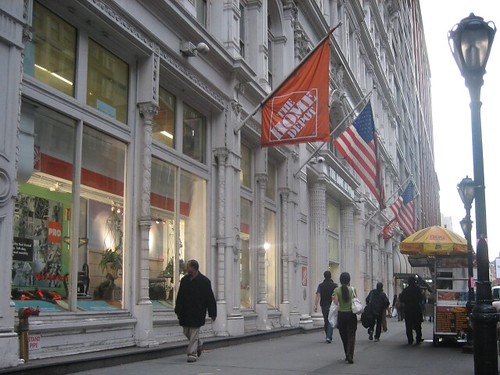
Previously, almost none of these stores would locate in an urban-style context, insisting on building boxes in massive parking lots as their exclusive business model. Some big-box stores still do not have an urban design and won’t go beyond their familiar suburban-style look. But these days, many have wised up and now have urban design templates. Savvier cities have found ways to woo these stores downtown (I was recently in an urban-style Best Buy in Manhattan; Manhattan's Home Depot is shown above).
In today’s economy it becomes more important than ever for cities to figure out how to utilize these stores as anchors for urban commercial corridors. In Philadelphia we have many of these big-box stores, but located far away from the downtown and major commercial corridors. It is well known that big box stores have relatively short life spans in suburban-style locations, often staying open only ten or fifteen years before seeking a new spot, leaving vacant “grayfields” behind. Philadelphia should make it a focus to ensure that when its South Philly big boxes close down that the City provides the carrots and sticks to bring these retail anchors to dense, urban-style commercial corridors. This is something the City should be thinking about proactively, rather than waiting for the not-so-distant day that one of the South Philly mega-retailers is ready to shut its doors and move to the next shopping center down the block.
I would argue that cities still have the strongest chance to keep small, diverse, and privately-owned retailers open, but it depends on their ability to understand the new market forces brought on by online shopping, and the necessity of centralizing their major retailers so as to create the critical mass of shoppers needed to provide the kind of retail we have traditionally come to expect from urban shopping. Small commercial corridors can certainly stay relevant based on the perpetual need for place-based, Internet-resilient businesses. However, downtowns and larger urban commercial corridors continue to need anchors.
Thursday, March 25, 2010
What We See: Advancing the Observations of Jane Jacobs

By Greg
In 1962, a journalist wrote of Jane Jacobs, “She has made a career of chopping city planners and urban renewal experts … into small pieces, which she feeds to cats.” After the publication of her landmark book, The Death and Life of Great American Cities (Random House, 1961), and subsequent tour across the nation – where she excoriated the latest trends in urban planning – Jane Jacobs has never fallen victim to a lack of interest or attention.
Jacobs famously kept a low profile and seldom spoke about herself to journalists and would-be biographers. Yet, during her lifetime a number of books and an endless pool of articles featured the housewife from Greenwich Village and her approach to urbanism that valued street smarts and informed observation over expert analysis and the will of powerful bureaucrats.
Since her passing in 2006, several important books have come out about Jacobs’ life and work. Two notables, Anthony Flint’s Wrestling with Moses: How Jane Jacobs Took On New York’s Master Builder and Transformed the American City (Random House, 2009), and Roberta Brandes Gratz’s The Battle for Gotham: New York in the Shadow of Robert Moses and Jane Jacobs (Nation Books, 2010), recall Jacobs’ battle of ideas with New York’s urban development czar, memorializing a triumph of Vox populi and the value of the human city over the sterile, mega-scale ideas of the Corbusian Ville Radieuse.
Without a doubt, the implications of Jacobs’ ideas, gleaned from her New York experience and expressed so well in Death and Life, continue to influence much contemporary urban thought. It is for that very reason that What We See: Advancing the Observations of Jane Jacobs (New Village Press, 2010) resonates so powerfully. In the book, over 30 authors reflect – in short and readable chapters – on the modern relevance of Jacobs’ ideas, explaining how Jacobs’ work influenced their own. These are not all academics, architects or urban designers; far from it. These voices refreshingly reflect Jacobs’ own disdain for compartmentalization of disciplines, with chapters by a theater company founder, bloggers and journalists, community activists, and elected officials, as well as the expected thought leaders, professors, and practitioners.
What We See provides a clear picture of the broad range of Jacobs’ influence – focusing not just on her New York years, but on her more numerous Toronto years, and the significance of her other books, namely The Economy of Cities (Random House, 1969). Much of What We See connects Jacobs’ work with contemporary urban ideas, such as environmental sustainability and buying local. The authors trace Jacobs’ impact to places as diverse as Missoula, Toronto, Germany, and Mumbai, capturing the breadth of her ideas as well as a smattering of biographical reflections from those who knew her and learned directly from “Jane.” The book tries to do many things, and amazingly generally succeeds.
After a foreword by Michael Sorkin (former architecture critic for The Village Voice), the book’s editors, Stephen A. Goldsmith and Lynne Elizabeth, describe the volume’s main theme: “What we see is largely who we are and what we have learned to see. There is no such thing as an objective observer.” The book then unfolds in six sections, and some of its un-objective observers are very engaging.
In “Jane Jacobs and the “Battle for the Street,” journalist Ray Suarez lays out an excellent and concise discussion of urban renewal, focusing on the rift between intentions of building a better society and the reality of the destruction that it caused. Mindy Thompson Fullilove embarks on a fascinating exploration of the psychology of social disruption and violence, resulting from the events of urban renewal. She analyzes the impacts of America’s “catastrophic urban policies,” which contributed to conditions that can be better understood, she argues, by studying the psychology of Japanese internment camps, prisons, and other places with severe social isolation.
The 2008 recipient of the Jane Jacobs Medal, Alexie M. Torres-Fleming, recounts her parallel Jane Jacobs story. As a Latina in the Bronx, she worked from the grassroots to empower a violence-plagued and disenfranchised community to carry out a robust and successful resident-led planning process. While Jacobs’ own story is often characterized by efforts to kill proposed highways and stop the demolition of neighborhoods, Torres-Fleming talks about the value of rebuilding – of engaging communities in planning a bright future. She writes, “Communities are not just streets and buildings: they are the sacred spaces made up of living, breathing people whose hopes and dreams are wrapped up in those same streets and buildings. Planning can elevate or diminish that reality.”
Perhaps the most provocative piece is Matias Echanove and Rahul Srivastava’s “The Village Inside,” which profiles the Dharavi slum of Mumbai. They portray Dharavi as a place that exemplifies the essence of Jane Jacobs’ philosophy and progressive urban ideology – mixed-use, creative communities, with live-work spaces, and vibrant locally sustained economies. The authors note that like many disinvested American urban neighborhoods, Dharavi is looked down upon by the government, which seizes on its “messy and makeshift appearance” as a rationale for redevelopment. Yet, this informal settlement exemplifies models of sustainable development that are sought after in wealthy, industrial cities.
Another notable piece is by Jaime Lerner, the firebrand former Mayor of Curitiba, Brazil, who famously reclaimed his city for pedestrians. Lerner challenges urban leaders to take decisive steps to improve our urban places, and asserts in the spirit of Jane Jacobs, “The idea that action should only be taken after all the answers and the resources have been found is a sure recipe for paralysis.”
Several of the authors creatively extend Jacobs’ ideas to broader concepts. Pierre Desrochers and Samuli Leppälä discuss the economics of “Jacobs spillovers,” the phenomenon that results from “…individuals who move frequently between different lines of work and/or regularly borrow ideas from fields other than the one they are working in.” Roberta Brandes Gratz talks about Jacobs’ “web thinking,” focusing on the way that issues are interconnected, debunking the allure of simplistic arguments. In one example she writes, “Yes, more electric cars and hybrids will help clean the air we breathe, but it won’t do anything to tame traffic, minimize the amount of land devoted to blacktop, limit sprawl, regenerate pedestrian-oriented places, or rebuild communities.”
Ironically (or perhaps appropriately) the most interesting chapters are the ones that have the least to do with Jane Jacobs. Janine Benyus’ chapter on biomimicry, and economist Saskia Sassen’s chapter on the intersection of the knowledge economy and 21st-century urban industry focus on themes that are, in one sense, related to Jacobs’ overall message, but on a broader level represent entirely independent scholarship.
While many chapters are highly enjoyable, and a handful are gems, some are less successful – overly simplistic, semantic, or jargony to the point of being nearly unreadable. A few seem to completely miss the essence of Jacobs’ message, like Clare Cooper Marcus’ chapter that encourages developments with cul-de-sacs and “privacy ‘buffer[s]’ such as a fenced yard or patio.” One weak point of What We See is its failure to adequately discuss the complexity of the Jacobs’ legacy. A few authors note criticisms of Jacobs – like her praise of the forces that ultimately led her beloved Greenwich Village to become hypergentrified – but overall the book reads like a Jacobs lovefest. Still, with so many different voices, and so much of the volume inspired by (rather than about) Jacobs, it holds together and feels satisfying by the end.
The book concludes with a lovely epilogue by Mary Rowe, recounting her personal interaction with Jacobs over tea, discussing the recovery of New Orleans after Hurricane Katrina. Jane tells her at one point, “You’re thinking like a bureaucrat. The people of New Orleans will decide what to do about their city – not you.” Thus, the book ends with Jacobs’ never-ending faith that communities will take care of themselves through grassroots, self-motivated, incremental progress – that top-down thinking can only do harm.
Yet this conclusion contrasts with the underlying message of many of the writers, who seem to believe that through innovation and a more accurate understanding of how cities really function (informed by Jacobs’ wisdom, of course), we can build healthier, more sustainable, more vital places for all kinds of people. It is a new, entrepreneurial, 21st-century outlook. Indeed, the true message of What We See is that we have a fresh generation of urban thought leaders who have learned from Jane Jacobs, but are intelligent, passionate, and innovative enough to develop their own ideas, messages, and strategies for action.
Tuesday, March 16, 2010
Homelessness: New Approaches to a Changing Problem
Remember that very successful food access and community development forum in the fall? Well the Philadelphia Committee on City Policy is hosting another panel discussion, this time focusing on the topic of homelessness. It should be a fascinating discussion on an important issue. I hope to see you there!
Homelessness: New Approaches to a Changing Problem
A Panel Discussion Hosted by The Philadelphia Committee on City Policy (PCCP)
Wednesday April 14, 2010
6:00-8:00 PM
The Center for Architecture (1218 Arch Street, Philadelphia)
Free for PCCP members, $5 for non-members
Light refreshments will be provided
The face of homelessness has changed over the decades. Oftentimes, people sleeping on the street are the most common reminder of the thousands of Philadelphians who lack shelter and food on any given night. However, many of us rarely see the true spectrum of homelessness – the hidden population of men, women and children who are struggling to break the cycle, or are just a paycheck away from homelessness. The city has recently seen an alarming increase of homeless families with children. Each year, thousands of individuals arrive in Philadelphia and lack the means to return to a place where they have a support system – leaving these “stranded travelers” in the City’s shelter system.
While the homeless population has changed, so have solutions to deal with this complex issue. Today, having individuals end up in a shelter is no longer considered a positive outcome. The City of Philadelphia and array of innovative nonprofit organizations are practicing solutions that work to develop long-term housing stability, address social and health issues, and help people work toward self sufficiency. Recent policies focus on targeting the systemic roots of homelessness, working to break the cycle. PCCP will host an expert panel to focus on innovative policy and programmatic solutions to address this critical and complex issue.
Panelists include:
Sr. Mary Scullion, Executive Director, Project H.O.M.E.
Roberta Cancellier, Deputy Director for Policy and Planning, Phila. Office of Supportive Housing
Ted Weerts, Ph.D. Executive Director, Travelers Aid Family Services of Philadelphia
Ted Weerts, Ph.D. Executive Director, Travelers Aid Family Services of Philadelphia
Joe Willard, Vice President of Policy, People’s Emergency Center
Moderator and opening speaker: Elaine Fox, Vice President of Specialized Health Services, Public Health Management Corporation and director of Philadelphia’s Health Care for the Homeless Program
Welcome remarks by Lynne Kotranski, Ph.D., member of PCCP’s Board of Directors and Vice President for Research and Evaluation, Public Health Management Corporation
Please RSVP to: suzydrinan@philcommitteeoncitypolicy.org
Wednesday, March 10, 2010
Urban Agriculture Workshops
By Greg
Income Opportunities in Urban Agriculture Workshops
Penn State Extension and The Enterprise Center will present two workshops on March 17, 2010: How to Write a Farm Business Plan (5:30-6:30PM) and How to Price Products for Market (7:00-9:00 PM). The workshops will be held at The Enterprise Center (4548 Market St., Philadelphia, PA 19139). Each workshop costs $10. For more information, please contact Nicole Sugerman.
Public Conversations and Public Art
By Ariel
This is a far more important recommendation than one might initially presuppose because it hints at a new way the city, communities and developers can interact when it comes to negotiating the impact on the community. Before I explain what I mean, a short digression is necessary to explain some of the problems with the process of community participation in planning and development. Be it a private developer who needs the community support to appear before a zoning commission, or a Streets/Highway/Transit Department that must complete an environmental review process before building a road or transit system, the builders of our cities must sit down with the communities who will feel the brunt of the impact of their project. The fact that developers and project builders must sit down with their community is not the problem, in fact it is rightly part of the whole development process. The benefit of such a process is two-fold, it is an opportunity to educate the public about a project, and it provides the developer (private or public) the political cover for some of their decisions. Problems arise can arise however when a community makes unfeasible demands or impractical demands and expectations are created for project aspects that are simply unable to be acted upon. It is one thing to ask for a place to sit, or a set-back in the highest portion of a tower, and it is another to expect a developer either not to go as tall as financially feasible or that they will fund the ongoing maintenance of a youth center. Out of such meetings, delays, costs and acrimony arise.
This is where public art comes in. At the crux of many communities’ complaints and demands is the sense that their community, where they have grown up and raised their children, is changing and that they have no voice or place in the future of their community. However Philadelphia’s Mural Arts Program has created a tried and true method of transferring the collective aspirations and values of a community and expressing it visibly on the vacant walls of the city’s many neighborhoods. By using the public art process as the main venue for public outreach during the building process developers (again, public or private) not only make the public a meaningful part of the development process, but they can act as partners to bring new identify, beauty and sense of identity to a place and project. The community sees themselves as a partner and the developer sees an added layer of investment in their project. Bringing in the OACCEE to the development process, to help encourage and steer the development of public art “tangible commitment to the public environment.” Ultimately a commitment to public art is an expression of our collective values, both for art in general and more importantly for its contributions to the city we live in.
Wednesday, February 17, 2010
I want to ride my bicycle...
By Ariel
Full disclosure, I work for Philadelphia's Mayor's Office of Transportation and Utilities. The following does NOT reflect any official policy of the City and only my own personal analysis.
Last month, the Philadelphia Bikeshare Concept Study was released. The study was commissioned for the City, the Bicycle Coalition of Greater Philadelphia and the William Penn Foundation. On its release it was met with great fanfare, the advocacy group Bikeshare Philadelphia proclaimed “YES to bike share! The study verifies the viability of a Public Use Bicycle Program for the City of Philadelphia.” It is worth it to take a much closer look at this excellently researched study for yourself; not only because the study actually answers a slightly different question than the advocates claim it does, but because viability means something different for institutions than it does for advocates.
The study answers two interrelated questions, is there a market for bikesharing in Philadelphia, and if someone were to build a Bikeshare system, what would it look like? It starts by building a map of where bikesharing could work in Philadelphia based upon the density of people, jobs and retail activity as well as the presence of tourist attractions, parks and transit stops. It is no surprise that the Central Business District (i.e. Center City and parts North and South) and University City constitute this core market.
While this mapping exercise describes what parts of the city would best support bikesharing it does not tell you how big such a program should be. To do that the study reviews three surveys done in Paris, Lyon and Barcelona, big dense cities with significant Bikeshare programs. In each of these cities surveys were conducted that essentially asked, “Without a shared bicycle how would you have completed your trip?” In Lyon 1.4% of the people surveyed would have taken a bus or a subway, while 4.6% of Parisians surveyed gave up transit to use bikeshare (far fewer people gave up their car to use Bikeshare, only .06% surveyed in Lyon and .18% in Barcelona). The study then applied these percentages to kinds of trips people take in Philadelphia within the aforementioned market area. They found that within the core market area, anywhere from 5,900 to 18,200 people might ride Bikeshare on any given day.
This means that for Philadelphia to build a Bikeshare system it would need to have 50 to 160 bike stations with anywhere from 770 to 2,370 bicycles, costing anywhere from $2 to $6 million to set up (the final recommendation is for a $4.4 million dollar initial program that would deploy 1,750 bicycles in only the initial phase).
The issue of money is a big one. Advocates point to the success of the Parisian system, suggesting that bikesharing systems must be built into street furniture contracts with the advertising companies that build bus shelters, etc. But they miss a very important fact: J.C. Decaux only offered to build a Bikeshare system so as to win the contract and Paris must now pay $1 million a year to subsidize the program. With ad revenues as an unpredictable source of funding, and with the city scraping every penny, bikesharing looks less and less attractive from a municipal standpoint. While in Barcelona they pay for bikesharing through a parking fee and looking at the Parking Authority as a “home” for a bikesharing system may be initially attractive, there are serious ramifications for it. The PPA contributes money not just to the City but the School District. Moreover, raising the cost of parking in the City is not an attractive option, just look at the pushback over the soda tax.
The study also notes other issues that must be addressed for a bikeshare program to work in Philadelphia. The City would of course need to “upgrade… the bike-lane/path network throughout the core area to provide safe circulation options for both expert and novice riders. [The City would also need to provide] aggressive levels of education and enforcement to minimize conflict among bikes, cars, and pedestrians on the city’s constrained streets and sidewalks.” It is here where a difference in perspective, between that of the advocate and that of a municipality further diverge.
So far all the easy bike lanes in Philadelphia have been set, more bike lanes, which would make it easier and more attractive for people to ride in Philadelphia, require taking away parking. If anything that would make drivers angrier at bicyclists, and we don’t need more of that. The number of people who park is far larger than those who bike, walk or take transit. And they vote.
In other words, the implementation issue is not simply a financial one, it is a political one. Are we as the City willing to make the trade-offs necessary, and even some of the sacrifices necessary to make bikesharing work? Are we willing to reduce the amount of money that goes to different programs to fund bikeshare? Unfortunately that is not a decision that just the advocates can make. In the end, the most significant challenge is the education one, not simply because the tension between bicyclists, pedestrians and drivers in Philadelphia is untenable, but because all Philadelphians need to see the benefit of bikesharing, not just the bicyclists.
Full disclosure, I work for Philadelphia's Mayor's Office of Transportation and Utilities. The following does NOT reflect any official policy of the City and only my own personal analysis.
Last month, the Philadelphia Bikeshare Concept Study was released. The study was commissioned for the City, the Bicycle Coalition of Greater Philadelphia and the William Penn Foundation. On its release it was met with great fanfare, the advocacy group Bikeshare Philadelphia proclaimed “YES to bike share! The study verifies the viability of a Public Use Bicycle Program for the City of Philadelphia.” It is worth it to take a much closer look at this excellently researched study for yourself; not only because the study actually answers a slightly different question than the advocates claim it does, but because viability means something different for institutions than it does for advocates.
The study answers two interrelated questions, is there a market for bikesharing in Philadelphia, and if someone were to build a Bikeshare system, what would it look like? It starts by building a map of where bikesharing could work in Philadelphia based upon the density of people, jobs and retail activity as well as the presence of tourist attractions, parks and transit stops. It is no surprise that the Central Business District (i.e. Center City and parts North and South) and University City constitute this core market.
While this mapping exercise describes what parts of the city would best support bikesharing it does not tell you how big such a program should be. To do that the study reviews three surveys done in Paris, Lyon and Barcelona, big dense cities with significant Bikeshare programs. In each of these cities surveys were conducted that essentially asked, “Without a shared bicycle how would you have completed your trip?” In Lyon 1.4% of the people surveyed would have taken a bus or a subway, while 4.6% of Parisians surveyed gave up transit to use bikeshare (far fewer people gave up their car to use Bikeshare, only .06% surveyed in Lyon and .18% in Barcelona). The study then applied these percentages to kinds of trips people take in Philadelphia within the aforementioned market area. They found that within the core market area, anywhere from 5,900 to 18,200 people might ride Bikeshare on any given day.
This means that for Philadelphia to build a Bikeshare system it would need to have 50 to 160 bike stations with anywhere from 770 to 2,370 bicycles, costing anywhere from $2 to $6 million to set up (the final recommendation is for a $4.4 million dollar initial program that would deploy 1,750 bicycles in only the initial phase).
The issue of money is a big one. Advocates point to the success of the Parisian system, suggesting that bikesharing systems must be built into street furniture contracts with the advertising companies that build bus shelters, etc. But they miss a very important fact: J.C. Decaux only offered to build a Bikeshare system so as to win the contract and Paris must now pay $1 million a year to subsidize the program. With ad revenues as an unpredictable source of funding, and with the city scraping every penny, bikesharing looks less and less attractive from a municipal standpoint. While in Barcelona they pay for bikesharing through a parking fee and looking at the Parking Authority as a “home” for a bikesharing system may be initially attractive, there are serious ramifications for it. The PPA contributes money not just to the City but the School District. Moreover, raising the cost of parking in the City is not an attractive option, just look at the pushback over the soda tax.
The study also notes other issues that must be addressed for a bikeshare program to work in Philadelphia. The City would of course need to “upgrade… the bike-lane/path network throughout the core area to provide safe circulation options for both expert and novice riders. [The City would also need to provide] aggressive levels of education and enforcement to minimize conflict among bikes, cars, and pedestrians on the city’s constrained streets and sidewalks.” It is here where a difference in perspective, between that of the advocate and that of a municipality further diverge.
So far all the easy bike lanes in Philadelphia have been set, more bike lanes, which would make it easier and more attractive for people to ride in Philadelphia, require taking away parking. If anything that would make drivers angrier at bicyclists, and we don’t need more of that. The number of people who park is far larger than those who bike, walk or take transit. And they vote.
In other words, the implementation issue is not simply a financial one, it is a political one. Are we as the City willing to make the trade-offs necessary, and even some of the sacrifices necessary to make bikesharing work? Are we willing to reduce the amount of money that goes to different programs to fund bikeshare? Unfortunately that is not a decision that just the advocates can make. In the end, the most significant challenge is the education one, not simply because the tension between bicyclists, pedestrians and drivers in Philadelphia is untenable, but because all Philadelphians need to see the benefit of bikesharing, not just the bicyclists.
Wednesday, February 10, 2010
Urban Farming Links
By Greg
While we wait for the blizzard here in Philly, I thought I'd get us thinking about spring with a few links to urban farm-related news.
First, in my day job we are building a mini-farm and grower's cooperative in West Philly. Here's a blog by one of the farm managers talking about the project's progress. I'll be sure to post more on this project in the coming months. Stay tuned.
I was interviewed recently by two U. Arts students working on a masters thesis to aggregate all of the urban farming resources and projects in Philadelphia. Philly has a ton of urban ag projects, but they are not well linked to each other. These students are hoping to identify what "needs to happen to transform the urban agricultural movement into a cohesive, effective system." Check out their blog.
Finally, across the country, in San Fran folks are turning an abandoned freeway ramp into a temporary urban farm. This looks pretty cool. Check it out!
For those of you on the east coast, enjoy the snow. Dream of spring.
Monday, February 1, 2010
Retooling Industrial Sites
This should be interesting (this Friday):
What: The Retooling Industrial Sites exhibit will showcase over 50 projects from more than 30 design firms. The projects include some of the leading examples of industrial reuse in Philadelphia as well as projects from cities across the country that demonstrate the exciting possibilities for transforming former industrial areas into productive uses—including urban manufacturing. The exhibit highlights the growing interest in revitalizing industrial sites and the important role design plays in the integration of industrial and residential areas. The exhibit is presented by the Community Design Collaborative in partnership with the Philadelphia Industrial Development Corporation as part of Infill Philadelphia: Industrial Sites, the third phase of the Collaborative’s initiative to promote workable, innovative design solutions to revitalizing older, urban neighborhoods.
When: Friday, February 5 from 5:30-7:30 pm. Meet the designers and see the innovative projects. The exhibit will be on view through March 26 and open Monday through Saturday from 10 am to 6 pm.
Where: Center for Architecture, 1218 Arch Street, Philadelphia 19107
More: Submissions selected for the exhibit represent a diverse mix of built and un-built projects from warehouse conversions to Brownfield redevelopment to new industrial buildings; they range in scope from single buildings to neighborhood master plans. The projects include manufacturing facilities, office buildings, schools, community centers and mixed-use housing. The featured projects pay homage to the industrial past and provide a vision for a new industrial and urban renaissance.
Saturday, January 30, 2010
Jane Jacobs, Robert Moses, Affordable Housing, and Gentrification


By Greg
For some time I have wanted to share my thoughts on a book that came out in 2009 called “Wrestling with Moses: How Jane Jacobs Took on New York’s Master Builder and Transformed the American City,” by Anthony Flint. The first thing worth noting is that Flint is not an academic. Rather he is the director of public affairs at a Cambridge-based think tank. The fact that Flint is involved in contemporary urban thought and policy is clear in the book. While it recounts historical events, Flint laces the book with references to modern ideas and events – tying the lessons of the past to the challenges and trends of the present and the future.
Most of us involved in urban development and planning are familiar with the work of Robert Moses and the way that Jane Jacobs contributed to permanently transforming the dialogue around urban redevelopment. This book provides a good refresher on the events surrounding several key “battles” in which Jacobs was involved in derailing urban renewal plans that Moses had a heavy hand in. For the general public who may not be familiar with this period of American urban history, Flint’s book is very accessible, recounting complex stories in a fairly concise (199 pages), engaging, and readable volume.
For folks who are already very familiar with these events, I urge you to read the book nonetheless, so you can get to the Epilogue. “Wrestling with Moses” is like a puzzle, selectively choosing elements out of the work of Jacobs and Moses, and building them together into a set of ideas that lay the groundwork for the Epilogue, which steps out of the historical and puts everything into its place in our modern context. By the end it is clear that the lessons the book brings to light are ones that are not just rooted in history, but that we need to address and discuss right now.
Flint spends a few pages explaining how profoundly Jane Jacobs shaped contemporary urban thought. He credits Jacobs’ work with a generation of “freeway revolts,” leading to halted highway projects and, more recently, highways torn down in cities across the U.S. Flint explains that “a new generation of citizen activists” saw Jacobs as “a kind of folk hero.” He recounts how professional organizations like the American Planning Association are incorporating Jacobs’ ideas into their core tenets. He discusses how her ideas influenced areas outside but related to planning, like crime prevention through environmental design.
Flint even goes beyond the planning profession (making a bit of a stretch, in my opinion) stating that “Everything from the design of workplaces to social media—the online networks of Facebook, YouTube, and open-source software—owes a debt to Jacobs and her original analysis of how decentralized, diverse, and ground-up systems function best.” He frames Jacobs as one of the seminal figures in American history leading to our current ideas about grassroots democracy.
Flint does not take the time to similarly clarify Moses’ contributions, perhaps because Moses’ work remains so obvious in physical development projects. Still, Flint points out that there has been some recent commentary on the need for a balanced philosophy that merges the best of Jacobs and Moses – the importance of investing in major infrastructure and also in community development and the human side of the city. He cites New York Times architecture critic Nicolai Ouroussoff, who wrote “A city, to survive and flourish, needs both perspectives.”
Doubtless, Jane Jacobs played an important role in asserting a mandate for citizen participation in urban planning and development, and for creating a methodology whereby organized citizens can successfully fight powerful government and private-sector actors. There is something so essentially American about the notion of people in a neighborhood rising up in their own best interest and fighting City Hall.
Yet, it is too easy to frame this story as one of a dictatorial Moses trying to impose his will over the defenseless citizens. To his credit, Flint does not quite tell the story this way. While Moses was a powerful public official and Jacobs was a Greenwich Village housewife, the title of the book indicates that the battle between them was not one-sided. One blogger remarks on this point “Flint’s book really isn’t about planning. It’s about power. Pure and simple. … No question, Moses was a bully. But so, in her way, was Jacobs.”
Jacobs became a role model for active citizens, showing how they could put the kibosh on just about any development they did not like. While Jacobs’ own ideology was more multi-faceted, Flint acknowledges, “… the kind of thoughtful citizen involvement Jacobs envisioned has evolved into mere NIMBYism—the protest of ‘not in my backyard.’” Today, with very little federal money going into urban redevelopment, and generations of citizens studying Jane Jacobs and her followers, public and private actors across the nation often struggle to get any major projects built. Jane Jacobs wrote about a proactive view of urban development, but she practiced a reactive one that now shapes our urban context perhaps as profoundly as urban renewal did fifty years ago.
On the flip side, public-sector administrators in the urban renewal era of the 1950s and 1960s focused on affordable housing as a critical goal. The problem was the reliance on modernist, high-rise towers as the template for how to best house the poor. Jacobs was a critic of this type of housing, and today, urbanists universally acknowledge that this architectural and planning decision was misguided.
However, we often bundle the urban renewal together, rather than looking at the diversity of ideas that emerged from the public sector in this period. Not all affordable housing of the era was built this way. For example, in Philadelphia’s Germantown section, a significant amount of affordable housing was produced through historic rehabilitation, while the fabric of the neighborhood was restored around it with infill development. Jane Jacobs loved this approach, on one trip to Philadelphia admiring how “intermingled with the new, were old buildings, which were being restored, and corner stores.”
Perhaps more important than recognizing the diversity of approaches in the urban renewal period is the overall concept of what the public sector was trying to do. What receives far less attention is the basic notion that a generation of public officials were trying to figure out how to build a significant amount of housing for the poor. Some of that housing got built, but much did not. Today we are seeing the consequences of not building nearly enough.
Urban America went through a racially explosive period in the 1960s, and then an overall era of decline in the 1970s. New York famously was on the brink of bankruptcy. However, the 1990s saw the start of a new resurgence of interest in urban living, and today a number of U.S. cities are booming, while many others are steadily climbing back. As Flint explains, in places like New York, “urban neighborhoods have become so wildly popular that only the wealthy—and predominantly white—can afford to live there.” Flint continues, “Jacobs was convinced that the city was the best possible place for people to live, and in many ways gentrification proved her right.”
Jane Jacobs’ writings and persona have become a major force in re-defining the city as a livable place for middle-class working professionals. However, this same philosophy arguably laid the groundwork for the hyper-gentrification of many urban areas, and the pricing out of the individuals and businesses that created the diversity that initially attracted her to Greenwich Village — the same diversity that attracts so many city lovers to urban neighborhoods across the U.S. today. Now there is even such a strong image of thriving, upscale urbanism that whole cities and parts of cities are practically devoid of economic diversity. Jane Jacobs, personally, was in favor of affordable housing, but the public sector that she vilified was for affordable housing too – and on a much larger scale. We often forget this.
In his book, Anthony Flint retells the story of the interaction between two figure who significantly shaped our contemporary urban issues of redevelopment, affordable housing, gentrification, the need for infrastructure, and the role of citizen participants. He concludes with an Epilogue that ties these historical events to modern-day challenges, and leaves us with a number of unanswered questions. The story of Jane Jacobs and Robert Moses is not about good and evil, but about the complexity of solving urban problems. The major question is: can we learn from the urban renewal era and apply its lessons to a contemporary world that is so different, and at the same time so much unchanged?
Tuesday, January 26, 2010
Good Things Do Happen
By Greg
“communities have been creating plans on their own, without clear guidelines or a means to integrate those plans with city action. The Planning Commission should produce a set of criteria, ensuring consistency among community plans. The city should reward compliance with these criteria by giving benefits to communities whose plans are adopted, such as grant funding or inclusion of projects in the capital program.”
Well, guess what… last week the Philadelphia City Planning Commission staff presented a set of Community Planning Guidelines to the Commission for its review. This would finally provide some consistency for neighborhood plans, provide an incentive for community groups to get their plans officially recognized, and provide a link between community-based planning and official City policy.
The guidelines are on the Commission’s website for public review, and will be voted on at the next monthly meeting of the Commission. If you want to go show your support, the next Commission meeting is Tuesday, February 16, 2010 at 1:00 PM at 1515 Arch Street, 18th Floor.
Sunday, January 24, 2010
Book Talk February 17th
By Greg
Please join me for a book talk on "Imagining Philadelphia: Edmund Bacon and the Future of the City." The event is scheduled for Wednesday Feb. 17, 2010 at 5:30 PM at the University of Pennsylvania Bookstore (3601 Walnut Street). The event, hosted by Penn IUR, will be followed by a reception. The authors present will be Scott Knowles, Eugenie Birch, Harris Steinberg, and me. I hope to see you there!
Monday, January 11, 2010
Transit Works
By Ariel Ben-Amos and Matt Crespi
Our sometime guest Matt Crespi brings us a thoughtful look at the importance of transit: namely that transit means jobs and more jobs than highways. Crespi does a great job of outlining the issue, and implicitly raises some more questions
- What does the investment in transit jobs mean for job growth and a tax base... How many more jobs would we need to create in transit for their to be a noticeable increase in the tax rolls for a city? Which leads to another question, what kind of transit service would we get out of that?
- More importantly, what kind of jobs are needed to maintain ongoing transit operations. Transit systems across the US are facing a critical staffing gap. As more and more engineering minded students go for hi paying jobs developing computer programs, there are fewer highly trained people able to maintain and fix the increasingly complex transit cars and subways.
What Crespi ultimately points to is that Philadelphia faces a challenge: how do we invest in people and transit for the betterment of both.
*
For decades we’ve known that investment in public transportation is often money well spent. In addition to encouraging more environmentally friendly behavior and serving as a keystone to any urban plan for sustainable development, it comes with numerous economic benefits. From attracting businesses to making a local labor market more efficient, good public transportation is a boon to residents in all socioeconomic strata. Now, thanks to a study by Smart Growth America, we can add one more fantastic claim to the list of benefits provided by that magic civic elixir: investment in public transportation creates almost twice as many jobs as other transportation projects.
Studying data from the American Recovery and Reinvestment Act, SGA found that a billion dollars devoted to public transportation produced 16,419 job months, where the same amount of money spent on a highway project produced a comparatively meager 8,781 job months. (What's a job month? A "job month" is a unit equal to one month of work for one person. The ARRA is less than a year old, so determining the exact retention rate, or creation of full-time jobs that are here to stay, is not yet possible. Estimates and experience, however, suggest that public transit creates at least as many jobs as investment in roads.)
Why the big difference? Building roads and highways requires significant amounts of land, while public transportation is more compact, complex and labor-intensive. Public transportation often requires a greater variety of skills to implement, which not only leads to more job creation, but also faster job creation (especially in areas with existing systems). Pennsylvania has been especially effective in turning stimulus money into jobs, and in less than a year has 100% of its Recovery Act funds under contract.
For Philadelphia, this affirms one of Mayor Nutter's key messages: improving sustainability doesn't have to be at odds with fighting a recession. Public transportation investment bring more jobs faster, and the jobs themselves are also greener. While a new highway and new public transportation can both reduce congestion, buses, trains and subways have a smaller environmental footprint, and the behavior they incentivize is far more sustainable.
Even ignoring superior job creation and environmental compatibility, the infrastructure itself would provide our region with a great return on investment. With SEPTA ridership increasing dramatically, more Philadelphians are prepared to embrace public transportation as a way of life than ever before (a trend holding true across the nation--the study points out that since 1995, transit use has grown at almost triple the rate of population growth). And now that we know the investment isn't just good for commuters and businesses, but also for the tax base and the city as a whole, the only thing stopping us is limited resources.
With this revelation, it is my hope that funding for public transportation will come in even more rapidly, as the rate of job creation currently seems capped only by limited government commitments. It would be nice if legislators in Harrisburg would wake up to the fact that allowing state transportation money to fund SEPTA projects is not a waste, but a way to raise state revenues and employ Pennsylvanians. That may be a pipe dream, but I think there is real hope that Washington will take notice. As the White House tries to get Americans back to work, future transportation funding initiatives might just include more funding for public transit than ever before.
The public opinion war is being won, and it's time for the supply to catch up with the demand. Public transportation too often seems to fall in the category of important but not urgent. But now, as we discover that these green investments create almost twice as many jobs as their land- and carbon-consuming counterparts, expanding public transit seems an ideal way to meet an urgent policy need while getting ready for a future which Philadelphians--and increasingly all Americans--are optimistically seeking.
Our sometime guest Matt Crespi brings us a thoughtful look at the importance of transit: namely that transit means jobs and more jobs than highways. Crespi does a great job of outlining the issue, and implicitly raises some more questions
- What does the investment in transit jobs mean for job growth and a tax base... How many more jobs would we need to create in transit for their to be a noticeable increase in the tax rolls for a city? Which leads to another question, what kind of transit service would we get out of that?
- More importantly, what kind of jobs are needed to maintain ongoing transit operations. Transit systems across the US are facing a critical staffing gap. As more and more engineering minded students go for hi paying jobs developing computer programs, there are fewer highly trained people able to maintain and fix the increasingly complex transit cars and subways.
What Crespi ultimately points to is that Philadelphia faces a challenge: how do we invest in people and transit for the betterment of both.
*
For decades we’ve known that investment in public transportation is often money well spent. In addition to encouraging more environmentally friendly behavior and serving as a keystone to any urban plan for sustainable development, it comes with numerous economic benefits. From attracting businesses to making a local labor market more efficient, good public transportation is a boon to residents in all socioeconomic strata. Now, thanks to a study by Smart Growth America, we can add one more fantastic claim to the list of benefits provided by that magic civic elixir: investment in public transportation creates almost twice as many jobs as other transportation projects.
Studying data from the American Recovery and Reinvestment Act, SGA found that a billion dollars devoted to public transportation produced 16,419 job months, where the same amount of money spent on a highway project produced a comparatively meager 8,781 job months. (What's a job month? A "job month" is a unit equal to one month of work for one person. The ARRA is less than a year old, so determining the exact retention rate, or creation of full-time jobs that are here to stay, is not yet possible. Estimates and experience, however, suggest that public transit creates at least as many jobs as investment in roads.)
Why the big difference? Building roads and highways requires significant amounts of land, while public transportation is more compact, complex and labor-intensive. Public transportation often requires a greater variety of skills to implement, which not only leads to more job creation, but also faster job creation (especially in areas with existing systems). Pennsylvania has been especially effective in turning stimulus money into jobs, and in less than a year has 100% of its Recovery Act funds under contract.
For Philadelphia, this affirms one of Mayor Nutter's key messages: improving sustainability doesn't have to be at odds with fighting a recession. Public transportation investment bring more jobs faster, and the jobs themselves are also greener. While a new highway and new public transportation can both reduce congestion, buses, trains and subways have a smaller environmental footprint, and the behavior they incentivize is far more sustainable.
Even ignoring superior job creation and environmental compatibility, the infrastructure itself would provide our region with a great return on investment. With SEPTA ridership increasing dramatically, more Philadelphians are prepared to embrace public transportation as a way of life than ever before (a trend holding true across the nation--the study points out that since 1995, transit use has grown at almost triple the rate of population growth). And now that we know the investment isn't just good for commuters and businesses, but also for the tax base and the city as a whole, the only thing stopping us is limited resources.
With this revelation, it is my hope that funding for public transportation will come in even more rapidly, as the rate of job creation currently seems capped only by limited government commitments. It would be nice if legislators in Harrisburg would wake up to the fact that allowing state transportation money to fund SEPTA projects is not a waste, but a way to raise state revenues and employ Pennsylvanians. That may be a pipe dream, but I think there is real hope that Washington will take notice. As the White House tries to get Americans back to work, future transportation funding initiatives might just include more funding for public transit than ever before.
The public opinion war is being won, and it's time for the supply to catch up with the demand. Public transportation too often seems to fall in the category of important but not urgent. But now, as we discover that these green investments create almost twice as many jobs as their land- and carbon-consuming counterparts, expanding public transit seems an ideal way to meet an urgent policy need while getting ready for a future which Philadelphians--and increasingly all Americans--are optimistically seeking.
Subscribe to:
Comments (Atom)