By Matt
This post is from our sometime contributor Matt C.
Small businesses create jobs, and everyone knows it, right? Mainstream media outlets and wonkish blogs alike have referred to small businesses as the "engine of job creation" for the United States. Talking heads sing their praises as local leaders woo them. Even Presidents extol the virtues of these diminutive economic saviors.
But even as leaders, reporters and conventional wisdom tell us that small businesses create jobs, new research is calling that assumption into question. This oft-repeated snippet of common knowledge may not actually carry the policy-driving implications we assign it. In one way, it's true that small businesses create a lot of jobs. The implied causality, however--that being small is what makes a business better able to create jobs--might be a complete illusion.
By analogy, consider this statistic: A lot of drownings occur on days during which a lot of ice cream is sold. It's 100% true. Drownings and ice cream sales are highly correlated. But while ice cream sales is a good predictor for drownings, there's a better one: temperature. When it's hot outside, people buy ice cream and go swimming (dramatically increasing drowning chances). Not every day with a lot of ice cream consumption leads to high drownings, but it's close enough to be useful if you don't have any weather information.
Likewise, economists and policy makers have been using the size of a business as a proxy for a much more important variable in predicting job creation potential: recency of entry to a labor market. To state the driving causal relationship, we shouldn't say that small businesses create jobs, but rather, that NEW businesses create jobs. And it just so happens that most new businesses are fairly small (just as most days with a lot of ice cream sold are reasonably warm).
Many small businesses are extremely weak engines of job creation, and most of them have been around for a while. Most sole proprietorships will never employ anyone for very long, and small, stable local businesses and stores don't expand their payrolls with much effectiveness. The small businesses which are best at creating jobs are the ones on their way to become large businesses; they don't stay small for decades. It's time to admit that the fifty year old corner store is not the engine of job creation for the country. It's Sergey and Larry, not Mom and Pop.
The age of the business is a better metric than size, but an even better indicator of hiring potential is the time a business has been in a particular labor market. A multinational conglomerate entering a new market can be an extremely powerful force for job creation. It's not discussed as widely and the impact of small businesses, but a one hundred year old company opening up a new plant or a new market is likely to create more jobs than entire towns full of small businesses.
Fine-tuning the metrics we use as predictors of job creation potential can help fine tune the "engine of job creation" so lauded in the press. Policy makers focusing incentives on new businesses instead of small businesses will be able to spend more wisely. Targeting small businesses in a major city can give hundreds of millions of dollars in tax breaks to some of the organizations least likely to create new jobs. But targeting new businesses only would be a more precise scalpel.
When Philadelphia looks to encourage economic growth, leaders should pay attention to all the research available on job creation. By eliminating business size as a criterion, we avoid repeating mistakes which have taken money out of public coffers in favor of independent consultants and small law firms whose personnel tend to be well off and stable in number. Alternative strategies haven't worked either; efforts to give job creation incentives by targeting new real estate developments usually accomplishes more job movement than creation (while leaving a lot of empty office space). New entrants to the job market are much more likely to respond to incentives, and policy makers should target them accordingly.
It's time to rethink our approach to economic incentives, and restructure our notions of the engine behind American job creation. We have to disassociate our yearning for the idyllic quiet American main street lined with shops and businesses from our economic policy. Recovery isn't going to found in small town storefronts, but rather in garages, basements, and yes, the board rooms of expanding multinational conglomerates. It's time to reform the refrain. Let's get used to saying, "New businesses are the engine of job creation in the United States."
Friday, May 21, 2010

Thursday, May 13, 2010
What parking really is
If you read Underground garage hits high-tech heights you will be forgiven thinking that the only interesting thing about the article is the technology described therein. However I was floored by the following quote: "This advanced technological solution to what he calls 'this building's tiny footprint' came from Parkway Corp.'s chairman and chief executive officer, Joseph S. Zuritsky, a partner in 1706 Rittenhouse with developer Tom Scannapieco." In Philadelphia, Parkway is associated with commuters looking for early bird pricing and diners who have given up driving around for half an hour and are finally willing to pay upwards of $20 to park. But Parkway is also a real estate development firm, their website notes that:
"Parkway has been in the field of real estate development for close to 70 years. We own, operate, and manage over 100 properties in the United States and Canada including surface and multi-level parking facilities. We have office space and retail space for lease as well as properties available for sale, and co-development."Cities across the US are only now beginning to realize that parking is not about just parking but it is about asset and land management. It's just a shame that they are far behind the curve of the parking lot companies themselves.
Tuesday, May 11, 2010
The Soul of a City
By Ariel
Cities have souls. If humans, themselves collections of sinews, organs and tissues can have souls, surely so can cities with their streets, parks and electric grids. While different religions ascribe different properties to the soul of a man or woman, there are a few more standard proxies for measuring the soul of a city. They amount largely to two things, the strength of the neurosis that its citizens have about their city, and the percentage of people currently living in the city who are from said city.
Neurosis: There used to be a billboard (or so I am told) along I-95 that read "Philadelphia: it's not as bad as Philadelphians say it is." Residents with cities with souls have a neurotic obsession with their cities, an obsession with the identity of the city and how things get done there. It does not have to all be neurotic, New Orleans felt like a city suffering from collective post traumatic stress disorder when I was there, and San Franciscans seem to have an enormous amount of near narcissistic love for their city, seeing the city as the reflection of their own potential and ethos. While I may use psychological terms fast and loose, I do believe that these cities all actively acknowledge or wrestle with a sense of identity and what it means to be from that city.
Percentage of Natives: When someone asks you in Philadelphia or New Orleans, what school did you go to, they mean, what High School did you go to (not, like in Manhattan or DC, what college). This is not just evidence of a sort of parochialism, it is also a sign that natives have deep roots in these cities. Having a high percentage of people from the city, distributed across income brackets, means that people across the city have memories of the city. A friend of mine living in Albania, had an address that said "Mike, above where Disco-My-Heart used to be, Behind where the rice factory used to stand." While cities need immigrants and churn, new people moving in and out, for a city to have a soul, it needs people who remember what used to be on that corner a decade a go.
I often flippantly say that DC has no soul, so many people move in and move out so quickly in that City that its neighborhoods are forgotten and without identity. My friends who are from DC argue with me, noting that such a characterization is only applicable for NW DC, a white capital-hill-centric DC. I would be willing to concede some of that, but if half the city does not pay attention to itself, well I still think its souless. Manhattan too, it could be argued, is loosing its soul as it becomes more and more expensive and more and more out-of-towners live their and have lost the memory of a grimier and livelier past.
Some of this may sound like simple urban romanticism, but in the end successful cities are those that encourage people to live in them and raise their children in them. Not all these cities are functional, but they do have people passionately fighting for, well, their souls.
Cities have souls. If humans, themselves collections of sinews, organs and tissues can have souls, surely so can cities with their streets, parks and electric grids. While different religions ascribe different properties to the soul of a man or woman, there are a few more standard proxies for measuring the soul of a city. They amount largely to two things, the strength of the neurosis that its citizens have about their city, and the percentage of people currently living in the city who are from said city.
Neurosis: There used to be a billboard (or so I am told) along I-95 that read "Philadelphia: it's not as bad as Philadelphians say it is." Residents with cities with souls have a neurotic obsession with their cities, an obsession with the identity of the city and how things get done there. It does not have to all be neurotic, New Orleans felt like a city suffering from collective post traumatic stress disorder when I was there, and San Franciscans seem to have an enormous amount of near narcissistic love for their city, seeing the city as the reflection of their own potential and ethos. While I may use psychological terms fast and loose, I do believe that these cities all actively acknowledge or wrestle with a sense of identity and what it means to be from that city.
Percentage of Natives: When someone asks you in Philadelphia or New Orleans, what school did you go to, they mean, what High School did you go to (not, like in Manhattan or DC, what college). This is not just evidence of a sort of parochialism, it is also a sign that natives have deep roots in these cities. Having a high percentage of people from the city, distributed across income brackets, means that people across the city have memories of the city. A friend of mine living in Albania, had an address that said "Mike, above where Disco-My-Heart used to be, Behind where the rice factory used to stand." While cities need immigrants and churn, new people moving in and out, for a city to have a soul, it needs people who remember what used to be on that corner a decade a go.
I often flippantly say that DC has no soul, so many people move in and move out so quickly in that City that its neighborhoods are forgotten and without identity. My friends who are from DC argue with me, noting that such a characterization is only applicable for NW DC, a white capital-hill-centric DC. I would be willing to concede some of that, but if half the city does not pay attention to itself, well I still think its souless. Manhattan too, it could be argued, is loosing its soul as it becomes more and more expensive and more and more out-of-towners live their and have lost the memory of a grimier and livelier past.
Some of this may sound like simple urban romanticism, but in the end successful cities are those that encourage people to live in them and raise their children in them. Not all these cities are functional, but they do have people passionately fighting for, well, their souls.
Wednesday, May 5, 2010
A TIGER drinks a Pepsi
By Ariel
Recently the Planning Collective partnered with the East Passyunk Avenue Business Improvement District to compete for $50,000 from Pepsi to transform a chaotic 6-way intersection into a community asset. They will, in essence, be bringing Broadway to South Philly: the very same reclamation of auto-dominated right of way and transformation into pedestrian node like was done in the heart of NYC and San Francisco could now emerge in Sou' Philly. I urge you to go here ,vote, and make this project a reality.
After you vote (early and often, in the truest of Philadelphia traditions) poke around the website, you will may see the future of planning in America.
As citizen's appetites for taxes diminishes even more rapidly, the federal, state and local governments have access to fewer and fewer funds to invest in their communities. This means not only that there is less money to play around with, but that it is harder to get. No wonder the US DOT made TIGER a competitive grant, it’s just disheartening that they received approximately $56 billion worth of proposed projects, for only $1.5 billion worth of funding. With less access to capital, planning and public investment will only get more competitive.
With foundations only able to pick up so much of the remaining tab (due to trust funds reduced by economic nose dives and their many different internal missions) it’s no wonder that the private sector is jumping in. I don’t know how many people have clicked on Pepsi’s website and registered their information to vote for their friends’ projects, but surely it’s worth the $1.3 million worth in grant funding they are distributing.
That being said, please do click here and help bring a little bit of green to South Philly.
Recently the Planning Collective partnered with the East Passyunk Avenue Business Improvement District to compete for $50,000 from Pepsi to transform a chaotic 6-way intersection into a community asset. They will, in essence, be bringing Broadway to South Philly: the very same reclamation of auto-dominated right of way and transformation into pedestrian node like was done in the heart of NYC and San Francisco could now emerge in Sou' Philly. I urge you to go here ,vote, and make this project a reality.
After you vote (early and often, in the truest of Philadelphia traditions) poke around the website, you will may see the future of planning in America.
As citizen's appetites for taxes diminishes even more rapidly, the federal, state and local governments have access to fewer and fewer funds to invest in their communities. This means not only that there is less money to play around with, but that it is harder to get. No wonder the US DOT made TIGER a competitive grant, it’s just disheartening that they received approximately $56 billion worth of proposed projects, for only $1.5 billion worth of funding. With less access to capital, planning and public investment will only get more competitive.
With foundations only able to pick up so much of the remaining tab (due to trust funds reduced by economic nose dives and their many different internal missions) it’s no wonder that the private sector is jumping in. I don’t know how many people have clicked on Pepsi’s website and registered their information to vote for their friends’ projects, but surely it’s worth the $1.3 million worth in grant funding they are distributing.
That being said, please do click here and help bring a little bit of green to South Philly.
Thursday, April 15, 2010
Neighbors to be heard on school building sales
By Ariel
The article "Neighbors to be heard on school building sales" is great news and a great opportunity to do some innovative public outreach. One of the biggest problems with public outreach is that when it's most thorough (i.e. when it's most extensive and has the most meetings), there is usually little opportunity to actually substantively change the project or include community feedback. By timing the public outreach with the actual transfer of title, the community gets in at the right point. Let's hope that the School District develops a process that does more than just listen to the community but also educates them (like a school district should) about development, and work collaboratively as the partners in the community they are.
The article "Neighbors to be heard on school building sales" is great news and a great opportunity to do some innovative public outreach. One of the biggest problems with public outreach is that when it's most thorough (i.e. when it's most extensive and has the most meetings), there is usually little opportunity to actually substantively change the project or include community feedback. By timing the public outreach with the actual transfer of title, the community gets in at the right point. Let's hope that the School District develops a process that does more than just listen to the community but also educates them (like a school district should) about development, and work collaboratively as the partners in the community they are.
Saturday, April 3, 2010
The Future of Urban Retail

By Greg
A recent Philadelphia Inquirer column by Inga Saffron was about a trendy clothing shop that recycled the interior of an out-of-business bathroom fixtures store to create a hip and “eclectic boutique.” Saffron’s point was to encourage retailers to “cherish the design resources that are already here,” especially in a recession when storefronts are changing over on a more frequent basis. What I found most intriguing about the column, however, was a secondary point that Saffron hints at.
Near the end of the column she writes, “Bookstores are not likely to survive when the world is fully Kindle-ized, except perhaps for specialty shops. Ditto for music stores.” This passing remark begs a much larger question: What is the future of urban retail in the Internet age? My father recently pointed out in conversation that the easiest way to find the answer is probably to analyze what we buy online, and what we are less likely to seek on the web. At the moment, the top candidates for the latter seem to be food, clothing and furniture, services (hair/nail salons, medical offices), personal banking, experiences (dining out, theater, clubs, bowling), and items we need right away (toilet paper, toothbrushes, medicine). In other words, the Internet has not only redefined retail, it continues to offer a guide to what retail businesses are good bets for the future.
This is not just an urban phenomenon. The Internet has also changed the retail landscape in the suburbs substantially. I grew up in the Philadelphia suburbs near the Plymouth Meeting Mall. On a recent business trip to a Plymouth Meeting office building, I was shocked to see that the mall’s exterior – once a blank wall, fronting the massive parking lots – was now activated, surrounded by dozens of new chain restaurants and a Whole Foods supermarket. In short, its management determined that the future of the mall was not rooted exclusively (or even primarily) in reviving the interior stores, but in bedecking its exterior with these Internet-resistant business categories.
Before the Internet, suburban-style big-box stores were the biggest threat to urban retail vitality. While some big-box chains that focus on the most Internet-vulnerable categories (like Borders) are threatened, it still seems like a number of national, big-box stores are fairly resilient today. Thus these major retailers are also necessarily part of the equation of figuring out urban retail in the Internet age.
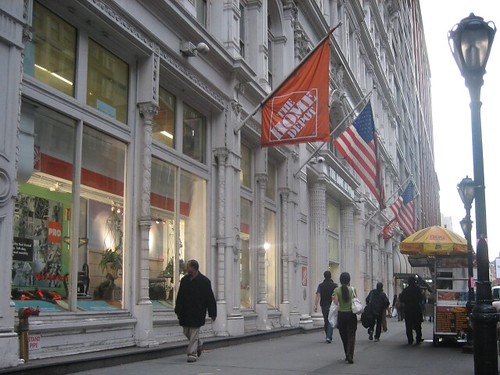
Previously, almost none of these stores would locate in an urban-style context, insisting on building boxes in massive parking lots as their exclusive business model. Some big-box stores still do not have an urban design and won’t go beyond their familiar suburban-style look. But these days, many have wised up and now have urban design templates. Savvier cities have found ways to woo these stores downtown (I was recently in an urban-style Best Buy in Manhattan; Manhattan's Home Depot is shown above).
In today’s economy it becomes more important than ever for cities to figure out how to utilize these stores as anchors for urban commercial corridors. In Philadelphia we have many of these big-box stores, but located far away from the downtown and major commercial corridors. It is well known that big box stores have relatively short life spans in suburban-style locations, often staying open only ten or fifteen years before seeking a new spot, leaving vacant “grayfields” behind. Philadelphia should make it a focus to ensure that when its South Philly big boxes close down that the City provides the carrots and sticks to bring these retail anchors to dense, urban-style commercial corridors. This is something the City should be thinking about proactively, rather than waiting for the not-so-distant day that one of the South Philly mega-retailers is ready to shut its doors and move to the next shopping center down the block.
I would argue that cities still have the strongest chance to keep small, diverse, and privately-owned retailers open, but it depends on their ability to understand the new market forces brought on by online shopping, and the necessity of centralizing their major retailers so as to create the critical mass of shoppers needed to provide the kind of retail we have traditionally come to expect from urban shopping. Small commercial corridors can certainly stay relevant based on the perpetual need for place-based, Internet-resilient businesses. However, downtowns and larger urban commercial corridors continue to need anchors.
Thursday, March 25, 2010
What We See: Advancing the Observations of Jane Jacobs

By Greg
In 1962, a journalist wrote of Jane Jacobs, “She has made a career of chopping city planners and urban renewal experts … into small pieces, which she feeds to cats.” After the publication of her landmark book, The Death and Life of Great American Cities (Random House, 1961), and subsequent tour across the nation – where she excoriated the latest trends in urban planning – Jane Jacobs has never fallen victim to a lack of interest or attention.
Jacobs famously kept a low profile and seldom spoke about herself to journalists and would-be biographers. Yet, during her lifetime a number of books and an endless pool of articles featured the housewife from Greenwich Village and her approach to urbanism that valued street smarts and informed observation over expert analysis and the will of powerful bureaucrats.
Since her passing in 2006, several important books have come out about Jacobs’ life and work. Two notables, Anthony Flint’s Wrestling with Moses: How Jane Jacobs Took On New York’s Master Builder and Transformed the American City (Random House, 2009), and Roberta Brandes Gratz’s The Battle for Gotham: New York in the Shadow of Robert Moses and Jane Jacobs (Nation Books, 2010), recall Jacobs’ battle of ideas with New York’s urban development czar, memorializing a triumph of Vox populi and the value of the human city over the sterile, mega-scale ideas of the Corbusian Ville Radieuse.
Without a doubt, the implications of Jacobs’ ideas, gleaned from her New York experience and expressed so well in Death and Life, continue to influence much contemporary urban thought. It is for that very reason that What We See: Advancing the Observations of Jane Jacobs (New Village Press, 2010) resonates so powerfully. In the book, over 30 authors reflect – in short and readable chapters – on the modern relevance of Jacobs’ ideas, explaining how Jacobs’ work influenced their own. These are not all academics, architects or urban designers; far from it. These voices refreshingly reflect Jacobs’ own disdain for compartmentalization of disciplines, with chapters by a theater company founder, bloggers and journalists, community activists, and elected officials, as well as the expected thought leaders, professors, and practitioners.
What We See provides a clear picture of the broad range of Jacobs’ influence – focusing not just on her New York years, but on her more numerous Toronto years, and the significance of her other books, namely The Economy of Cities (Random House, 1969). Much of What We See connects Jacobs’ work with contemporary urban ideas, such as environmental sustainability and buying local. The authors trace Jacobs’ impact to places as diverse as Missoula, Toronto, Germany, and Mumbai, capturing the breadth of her ideas as well as a smattering of biographical reflections from those who knew her and learned directly from “Jane.” The book tries to do many things, and amazingly generally succeeds.
After a foreword by Michael Sorkin (former architecture critic for The Village Voice), the book’s editors, Stephen A. Goldsmith and Lynne Elizabeth, describe the volume’s main theme: “What we see is largely who we are and what we have learned to see. There is no such thing as an objective observer.” The book then unfolds in six sections, and some of its un-objective observers are very engaging.
In “Jane Jacobs and the “Battle for the Street,” journalist Ray Suarez lays out an excellent and concise discussion of urban renewal, focusing on the rift between intentions of building a better society and the reality of the destruction that it caused. Mindy Thompson Fullilove embarks on a fascinating exploration of the psychology of social disruption and violence, resulting from the events of urban renewal. She analyzes the impacts of America’s “catastrophic urban policies,” which contributed to conditions that can be better understood, she argues, by studying the psychology of Japanese internment camps, prisons, and other places with severe social isolation.
The 2008 recipient of the Jane Jacobs Medal, Alexie M. Torres-Fleming, recounts her parallel Jane Jacobs story. As a Latina in the Bronx, she worked from the grassroots to empower a violence-plagued and disenfranchised community to carry out a robust and successful resident-led planning process. While Jacobs’ own story is often characterized by efforts to kill proposed highways and stop the demolition of neighborhoods, Torres-Fleming talks about the value of rebuilding – of engaging communities in planning a bright future. She writes, “Communities are not just streets and buildings: they are the sacred spaces made up of living, breathing people whose hopes and dreams are wrapped up in those same streets and buildings. Planning can elevate or diminish that reality.”
Perhaps the most provocative piece is Matias Echanove and Rahul Srivastava’s “The Village Inside,” which profiles the Dharavi slum of Mumbai. They portray Dharavi as a place that exemplifies the essence of Jane Jacobs’ philosophy and progressive urban ideology – mixed-use, creative communities, with live-work spaces, and vibrant locally sustained economies. The authors note that like many disinvested American urban neighborhoods, Dharavi is looked down upon by the government, which seizes on its “messy and makeshift appearance” as a rationale for redevelopment. Yet, this informal settlement exemplifies models of sustainable development that are sought after in wealthy, industrial cities.
Another notable piece is by Jaime Lerner, the firebrand former Mayor of Curitiba, Brazil, who famously reclaimed his city for pedestrians. Lerner challenges urban leaders to take decisive steps to improve our urban places, and asserts in the spirit of Jane Jacobs, “The idea that action should only be taken after all the answers and the resources have been found is a sure recipe for paralysis.”
Several of the authors creatively extend Jacobs’ ideas to broader concepts. Pierre Desrochers and Samuli Leppälä discuss the economics of “Jacobs spillovers,” the phenomenon that results from “…individuals who move frequently between different lines of work and/or regularly borrow ideas from fields other than the one they are working in.” Roberta Brandes Gratz talks about Jacobs’ “web thinking,” focusing on the way that issues are interconnected, debunking the allure of simplistic arguments. In one example she writes, “Yes, more electric cars and hybrids will help clean the air we breathe, but it won’t do anything to tame traffic, minimize the amount of land devoted to blacktop, limit sprawl, regenerate pedestrian-oriented places, or rebuild communities.”
Ironically (or perhaps appropriately) the most interesting chapters are the ones that have the least to do with Jane Jacobs. Janine Benyus’ chapter on biomimicry, and economist Saskia Sassen’s chapter on the intersection of the knowledge economy and 21st-century urban industry focus on themes that are, in one sense, related to Jacobs’ overall message, but on a broader level represent entirely independent scholarship.
While many chapters are highly enjoyable, and a handful are gems, some are less successful – overly simplistic, semantic, or jargony to the point of being nearly unreadable. A few seem to completely miss the essence of Jacobs’ message, like Clare Cooper Marcus’ chapter that encourages developments with cul-de-sacs and “privacy ‘buffer[s]’ such as a fenced yard or patio.” One weak point of What We See is its failure to adequately discuss the complexity of the Jacobs’ legacy. A few authors note criticisms of Jacobs – like her praise of the forces that ultimately led her beloved Greenwich Village to become hypergentrified – but overall the book reads like a Jacobs lovefest. Still, with so many different voices, and so much of the volume inspired by (rather than about) Jacobs, it holds together and feels satisfying by the end.
The book concludes with a lovely epilogue by Mary Rowe, recounting her personal interaction with Jacobs over tea, discussing the recovery of New Orleans after Hurricane Katrina. Jane tells her at one point, “You’re thinking like a bureaucrat. The people of New Orleans will decide what to do about their city – not you.” Thus, the book ends with Jacobs’ never-ending faith that communities will take care of themselves through grassroots, self-motivated, incremental progress – that top-down thinking can only do harm.
Yet this conclusion contrasts with the underlying message of many of the writers, who seem to believe that through innovation and a more accurate understanding of how cities really function (informed by Jacobs’ wisdom, of course), we can build healthier, more sustainable, more vital places for all kinds of people. It is a new, entrepreneurial, 21st-century outlook. Indeed, the true message of What We See is that we have a fresh generation of urban thought leaders who have learned from Jane Jacobs, but are intelligent, passionate, and innovative enough to develop their own ideas, messages, and strategies for action.
Subscribe to:
Posts (Atom)